ZODIAC CIPHERS
RICHARD GRINELL, COVENTRY, ENGLAND
  • Home
    • Search This Site With Google
    • The Mount Diablo Map and Code Solution
  • Zodiac News
    • Zodiac News Archive
    • Santa Barbara Attack
    • Cheri Jo Bates
    • The Confession
    • Riverside Desktop Poem
    • Bates Letter
    • The Forgotten Victims
    • Welsh Chappie - Zodiac News
  • Lake Herman Murders
    • Blue Rock Springs Attack
    • Vallejo Times Letter
    • Examiner Letter
    • Chronicle Letter
    • Complete 408 Cipher
    • Vallejo and Benicia Map
    • Kathie Snoozy and Debra Furlong Murders
    • Debut of Zodiac Letter
  • Lake Berryessa Attack
    • Presidio Heights Attack
    • Call to Chat Show
  • 340 Cipher
    • Bus Bomb Letter
    • Betsy Aardsma Murder
    • The Fairfield Letter
    • Melvin Belli Letter
    • Santa Barbara Murders 1970
    • Modesto Attack
    • My Name is Cipher
    • Dragon Card and Button Letter >
      • Phillips Road Map
    • The Sleeping Bag Murders
    • The Little List Letter
  • The Halloween Card
    • Lake Tahoe Disappearance
    • Los Angeles Times Letter
    • The Monticello Card
    • The Exorcist Letter
  • SLA Letter
    • Red Phantom Letter/American Greetings Card
    • The 1978 Letter
    • Los Angeles Times Newspaper Articles
    • Zodiac Letters Real or Fake
    • Zodiac Documentary
    • Unsolved Mysteries
    • The Colonial Parkway Murders
  • Suspects
    • Arthur Leigh Allen
    • Rick Marshall
    • Lawrence Kane
    • Theodore Kaczynski
    • Richard Gaikowski
    • Gareth Penn
    • Jack Tarrance

FOUR AND A HALF YEARS OF "ME"

11/1/2025

 
PictureTHE Z13 CIPHER WHEEL
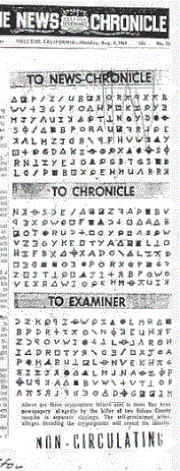
There are only four communications from July 31st 1969 to January 29th 1974 where the Zodiac Killer teased us with his identity or name. The letter to the San Francisco Chronicle on July 31st 1969 promised that "in this cipher is my idenity", but only gave us 18 characters that seemingly have no discernible message. The April 20th 1970 letter with a thirteen character code tempted us with "my name is". The October 27th 1970 "Halloween" card began with the message "I feel it in my bones you ache to know my name. And so I'll clue you in". And finally, the January 29th 1974 "Exorcist" letter substituted part of the "Tit-Willow" verse for a signature, by introducing the verse with "Signed, yours truley". The Zodiac Killer teased us in each instance - yet to this day - no common thread has been found linking all four Zodiac offerings together. However, the following presentation will serve up the same "identity" in all four communications. An identity (if correct)  that would clearly have been chosen as a joke.
​
The first is incredibly tenuous, but it does exist. The deciphered portion of the 408 cipher mailed to the San Francisco Chronicle on July 31st 1969 gave us 18 letters of illegible text, yet within these 18 apparently meaningless letters the Zodiac Killer may have placed his signature, shown inside the yellow rectangle below. This suggestion is wholly unconvincing on its own, but hopefully the remainder of this analysis will maybe change your mind.

Picture
THE 18 UNEXPLAINED CHARACTERS AT THE FOOT OF THE 408 CIPHER
Picture
THE Z13 CODE MAILED ON APRIL 20TH 1970
Picture
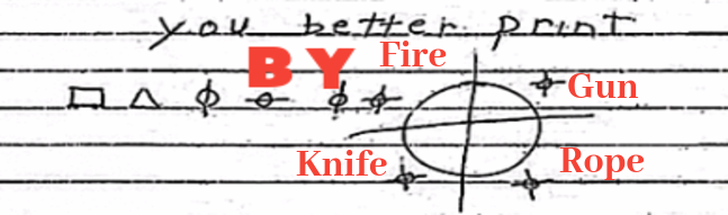
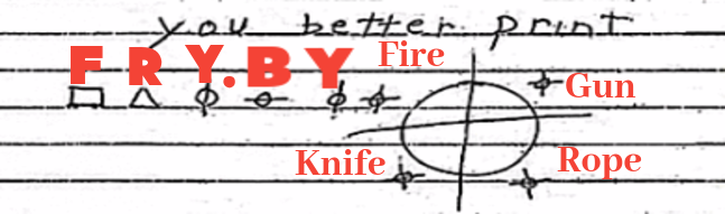
The April 20th 1970 "13-Symbol" code letter, I have argued had the key of 888, derived from the murderer's pseudonym in the 340 cipher (see here), which when applied to the Z13 code with a right shift of 8, gave us the signature of "ME ⊕" ("ME" followed by the Zodiac crosshairs). In other words, when cycling 8 positions to the right from each "circled 8", we get the signature of "ME" and his "gunsight" logo.

​If the Halloween card on October 27th 1970 was going to give us the answer of "ME" proposed in the 408 cipher and Z13 code, you would expect to find this word embedded in its design. Not only was the word "ME" curiously obvious in the Halloween card inner, it was present twice. The Zodiac Killer was clearly employing the eye in the knothole of the tree as himself, by surrounding the knothole with the ominous threat of "Peek-a-boo you are doomed".

But there is one striking feature about the writing on the tree. After the phrase "PEEK-A-BOO" the Zodiac Killer positions the word "DOOMED", such that the "ME" lines up with "PEEK-A-BOO" to create "PEEK-A-BOO, ME". It is definitely noticeable that the word "ME" is visibly larger and bolder than the rest of the writing, as if to place emphasis on this pronoun. The skeleton's left arm is also affixed to the Halloween card in such a manner that it separates the word "GAME" to spell "ME". The word "BOO" is written on the card inner at a 45 degree angle so that it too lines up with the word "ME".

The word "BOO" around the knothole and the word "BOO" to the immediate left of the skeleton, are both positioned in alignment with the word "ME". Was the Zodiac Killer giving us the answer of "ME" to "I feel it in my bones you ache to know my name. And so I'll clue you in"? Thereby replicating the answer of "ME" possibly given by the proposed solution to the Z13 code on April 20th 1970. And the signature of "ME" sitting innocuously within the 18 characters of the 408 cipher.

Picture
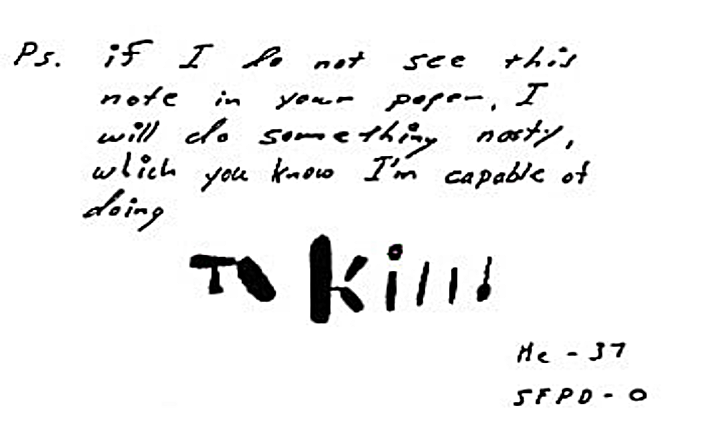
Finally, on January 29th 1974, the Zodiac Killer probably got tired of playing games and outright gave us his signature in plain sight, by writing "Me - 37". In fact, he effectively gave us the signature of "Me" (or "ME") a total of three times in the "Exorcist" letter. The first, as already explained, sat alongside his running victim count. The second was in the words "Signed, yours truley", because while it is often used in formal and semi-formal correspondence, in some specific contexts, it can also be used humorously or self-referentially in conversation to mean "myself". The signature of "yours truly" simply means "me". The third can be shown by using the "Tit-Willow" verse that followed "Signed, yours truley".

When we look at the Exorcist letter mailed on January 29th 1974, the Zodiac Killer appears to add the "Tit-Willow" verse from "The Mikado" for no apparent reason. However, the verse was preceded by "Signed, yours truley;" and may suggest that his identity of "Me" should be found somewhere within the verse. This concept hit a roadblock, until I looked up the following line from the complete song. The Zodiac Killer plagiarised the section below (marked in red) to place into his letter. The next line in the below verse (marked in blue) reads, in part, "Now I feel just as sure as I'm sure that my name Is". which the Zodiac Killer wrote on April 20th 1970 to introduce his Z13 code, that has already been shown to easily create the signature of "ME" and his crosshairs. Therefore, we have the "Exorcist" letter with a signature of "Me -37", the phrase of "yours truley" which means "me", introducing a "Tit-Willow" verse whose next line contains "my name is", that preceded the Zodiac Killer's Z13 code, which by using the three circled 8's as a mathematical tool, easily creates the signature of "ME". A "Tit-Willow" verse, by the way, which is split into three sections of eight lines, just like the 408 cipher. 

​July 31st 1969: "I will not give you my name because you will try to slow down or stop my collecting of slaves for my afterlife", but "in this cipher is my identity". EBEORIETEMETHHPITI.

August 4th 1969: "By the way, are the police having a good time with the code? If not, tell them to cheer up; when they do crack it, they will have me".

Picture
On a tree by a river a little tom-tit
Sang "Willow, tit willow, tit willow"
And I said to him, "Dicky-bird, why do you sit
Singing 'Willow, tit willow, tit willow'" "
Is it weakness of intellect, birdie?"
I cried "Or a rather tough worm in your little inside"
With a shake of his poor little head, he replied
"Oh, willow, tit willow, tit willow!".

He slapped at his chest, as he sat on that bough
Singing "Willow, tit willow, tit willow"
And a cold perspiration bespangled his brow
Oh, willow, tit willow, tit willow
He sobbed and he sighed and a gurgle he gave*
Then he plunged himself into the billowy wave
And an echo arose from the suicide's grave
"Oh, willow, tit willow, tit willow".


Now I feel just as sure as I'm sure that my name
Is
n't Willow, tit willow, tit willow
That 'twas blighted affection that made him exclaim
"Oh, willow, tit willow, tit willow"
And if you remain callous and obdurate,
I Shall perish as he did, and you will know why
Though I probably shall not exclaim as I die
​"Oh, willow, tit willow, tit willow".

ALSO: CRACKING THE CRACKPROOF AND AN IDENTITY IN THE HALLOWEEN CARD

LAMB TO THE SLAUGHTER

9/7/2025

 
Picture
Michael Butterfield has covered the idea of Alfred Hitchcock Presents possibly having some influence on the Zodiac Killer, when the murderer stated in the "Debut" letter on August 4th 1969: "What I did was tape a small pencel flash light to the barrel of my gun. If you notice, in the center of the beam of light if you aim it at a wall or ceiling you will see a black or darck spot in the center of the circle of light about 3 to 6 inches across. When taped to a gun barrel, the bullet will strike in the center of the black dot in the light". He would back this claim up on November 9th 1969 when he wrote "To prove that I am the Zodiac, Ask the Vallejo cop about my electric gun sight which I used to start my collecting of slaves."  

In a series of 268 episodes running from 1955 to 1962, Museum Piece aired on April 4th 1961, in which a gun mounted sight on a .22 caliber rifle was used to aid in the hunting of victims, with a cursory mention of "The Most Dangerous Game" in the episode. The suggestion was that the Zodiac Killer may have watched Alfred 
Hitchcock Presents and used this sighting implement in his first attack at Lake Herman Road on December 20th 1968, before describing it in the "Debut" letter 7 1/2 months later.

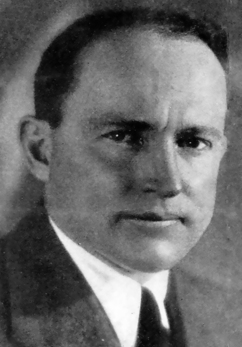
Sir Howard Grubb (1844–1931) was an Irish optical engineer renowned for designing and manufacturing high-quality astronomical instruments, including some of the largest telescopes of the 19th century. He inherited and later expanded his father's company, cementing its reputation for precision optics. His innovations also included the invention of the reflector sight and improvements to the submarine periscope. In 1900, Grubb invented the reflector or "reflex" sight, a non-magnifying optical sight that uses a collimator to allow the viewer looking through the sight to see an illuminated image of a reticle or other pattern in front of them that stays in alignment with the device the sight is attached to (parallax free). This type of sight has come to be used on all kinds of weapons from small firearms to fighter aircraft.

​Using this principle, an "electric gun sight" was featured in the monthly publication of "Popular Mechanics" in the early 20th century. Michael Butterfield wrote "The Zodiac was not the first to conceive of a light attached to the barrel of a gun. Articles about a gun light had appeared in the magazine Popular Mechanics as far back as 1922 and 1933". However, the idea of an "electric gun sight" appeared in "Popular Mechanics" a little bit earlier than Michael suggested. The concept first appeared in "Popular Mechanics" in December 1908, and was featured in the San Jose Tribune, Bay Area newspaper on December 20th 1908, the very same day and month that Zodiac claimed he used an electric gun sight in his Lake Herman Road attack. The dates lining up is probably nothing more than coincidence, but it is noteworthy nonetheless.    

Picture
SCREENSHOTS FROM ALFRED HITCHCOCK PRESENTS "MUSEUM PIECE" (1961)
PictureAHP: "LAMB TO THE SLAUGHTER" (1958)
In a recent series of articles I attempted to show the thought process of one mind when exploring the feasibility that the Zodiac Killer may have composed communications in both Riverside and the Bay Area, through phrases such as "man is the most dangerous animal of all" and "it was about time for her to die". The thinking being that both the author in Riverside and the Bay Area used microfiche searches at the library when manufacturing the 408 cipher on July 31st 1969 and the "Confession" letter on November 29th 1966. One mind, therefore placing the Zodiac Killer in Riverside just after the murder of Cheri Jo Bates on October 30th 1966. The Confession letter author claimed "I am not sick. I am insane. But that will not stop the game", while the author of the July 31st 1969 letters referenced "The Most Dangerous Game" from 1932. But were there any signs of "Alfred Hitchcock Presents" in the Confession letter on November 29th 1966, therefore binding further the two authors? 

The Confession letter author typed "
Miss Bates was stupid. She went to the slaughter like a lamb", yet they twisted the phrase "lamb to the slaughter", which comes from the Bible, specifically the Old Testament books of Isaiah and Jeremiah describing a righteous person being led to death without protest. The phrase symbolizes an innocent, unaware person being led to their own destruction. 

​In the Roald Dahl 1953 short story "Lamb to the Slaughter", the title serves as a dark, dual-meaning metaphor for Mary Maloney, who is initially an innocent, loving wife, but becomes the cunning killer who commits the act of slaughter with the leg of lamb itself. After murdering her husband with a frozen leg of lamb, she then cooks the meat to destroy any evidence and ends up serving the murder weapon in a dinner to responding law enforcement, who kindly oblige and eat the meal. While consuming the lamb, as Mary sits nearby but does not join them, the policemen discuss the murder weapon's possible location. One officer, his mouth full of meat, says it is "probably right under our very noses." I explored the possibility that the author of the Confession letter may have watched or read something about this Roald Dahl story, until I discovered that it had been made into an episode on "Alfred Hitchcock Presents" on April 13th 1958 under the same title of "Lamb to the Slaughter".  

PictureALFRED HITCHCOCK PRESENTS
If this phrase had been in the Confession letter author's mind when he typed this communication and subsequently mailed it to the Riverside Homicide Detail and Riverside Press-Enterprise newspaper, had he recently watched the Alfred Hitchcock Presents episode "Lamb to the Slaughter" in Riverside? Using a newspaper archive search in "Genealogy Bank" using the terms "Lamb to the Slaughter", "California" and the year "1966", I could find only three newspapers advertising this episode (using this platform), but crucially, all three were in November (and one was in Riverside).

​They were the Riverside Daily Press on November 5th 1966, Long Beach Press-Telegram on November 6th 1966 and Long Beach Independent on November 10th 1966. The show was due to air on Thursday, November 10th 1966 on KTLA (channel 5) from Los Angeles, about two weeks before the Confession letter author began typing the two Confession letters. It may have featured elsewhere in America during the year, but importantly, a Riverside resident could have viewed the episode "Lamb to the Slaughter" on television just fourteen days (or slightly more) before they typed "Miss Bates was stupid. She went to the slaughter like a lamb" into the Confession letters. It is impossible to say if a correlation exists between the two because we would have to know the mind of the author. However, if the Confession letter author did derive inspiration from "Alfred Hitchcock Presents" in Riverside in 1966, did this inspiration spill over to December 20th 1968, August 4th 1969 and November 9th 1969, when his "electric gun sight" took center stage? A murderer called Zodiac who possibly enjoyed murder mysteries. Who would have guessed.      

Picture
Picture
AIRED ON NOVEMBER 10TH 1966

THE IDENTITY IN THE 408 CIPHER

8/10/2025

 
Picture
It has long been thought that the Zodiac Killer had a penchant for the theater, movies and comic books, based upon his letter writing to the newspapers. We don't know whether this was a protracted case of misdirection by the Zodiac Killer, who was simply playing to the audience, or whether the themes he portrayed in his communications were an extension of himself. We know that he was inspired by the exact words of Merian C. Cooper, the associate producer of "The Most Dangerous Game" (1932), when he created his 408 cryptogram and enciphered the phrase "man is the most dangerous animal of all" - but did any other movies have an influence in the design of his July 31st 1969 letters to the Vallejo Times-Herald, San Francisco Examiner and San Francisco Chronicle?

​The Zodiac Killer wrote "In this cipher is my idenity" in the Chronicle letter, to which he added the third portion of cipher, stating "I will not give you my name because you will try to slow down or stop my collecting of slaves for my afterlife". In other words, he promised us an identity, but when the 408 cipher was decoded he assured us that it wouldn't be his name. We know of two identities for the Bay Area murderer [1] The "Zodiac", and [2] "Z". These appeared first in the August 4th 1969 "Debut" letter, and the October 27th 1970 "Halloween" card. One of these identities should be hidden in the 408 cipher if the Zodiac Killer was telling the truth. Unfortunately we have 18 unsolved characters in the 408 cipher which nobody has adequately explained, until David Oranchak highlighted the concept of a missing line. 

One other movie that the Zodiac Killer may have been influenced by was "The Mark of Zorro" released in 1920 and 1940, featuring an individual who had a secret identity of Don Diego de la Vega, a wealthy nobleman who lived in Los Angeles during the Spanish colonial era. By night, he transformed into the masked vigilante "Zorro" (Z), fighting the injustice and oppression of the corrupt. This duality allowed him to operate with impunity, as his true identity remained hidden from those he sought to neutralize. He was a type of masked superhero who left his signature or identity in the form of the letter "Z", often carved onto his slain victims by virtue of his sword. Somebody the Zodiac Killer may have identified with when he masked up for his "adventure" on the shores of Lake Berryessa on September 27th 1969, armed with a bayonet-type weapon. The whole concept of Zorro was a masked man who had ties to early California, whose "secret identity" was cloaked behind the letter "Z" that signed his perilous work. Sounds like the October 27th 1970 "secret pal" card, signed with a "Z". But how does the word "identity" and the signature "Z" tie in with the 408 cipher. The letter mailed to the San Francisco Chronicle newspaper on July 31st 1969 carried the wording "In this cipher is my idenity", so where is the letter "Z" in the third and final portion of cipher mailed to the Chronicle?
Picture
THE "MARK OF ZORRO" (1940) WAS RELEASED IN THE USA (AND CALIFORNIA) ON NOVEMBER 8TH, WHICH TIED WITH THE DATE OF HIS FOLLOWING 340 CIPHER
Picture
Count Zaroff was the murderous host of "Ship Trap" Island, where unlucky sailors were lured to their fate of being hunted for sport in "The Most Dangerous Game" (1932). Zorro was the masked avenger seeking to right the wrongs of society with his trademark signature that struck fear into his adversaries. The Zodiac Killer seemingly flipped the script and lashed out at the innocent in a society that he had developed an animosity towards - but in all cases - the leading protagonist carried an identity beginning with the letter "Z". Bearing in mind that these two movies may have had an influence on the thinking of the Zodiac Killer, it isn't unrealistic to believe he adopted the letter "Z" from the pseudonym "Zodiac" and inserted it in position 408 in his cipher. An identify just like "Zorro".

​It is a fair to good assumption that the Zodiac Killer made a draft version of his 408 message in a grid of 17 by 24 characters, to be enciphered and mailed in three parts of 136 characters to the Vallejo Times-Herald, San Francisco Examiner and San Francisco Chronicle - but he made a mistake during this process when moving from the San Francisco Examiner to the San Francisco Chronicle newspaper. The problem was that the first three lines of the Chronicle section may have all began with the letter "E", so he likely accidentally missed out line 17 from his draft version of the message and continued his enciphering to the Chronicle beginning on line 18 instead (see associated image).

​This created the error in the deciphered message of "The best part of it is that when I die I will be reborn in paradice and all the (?) I have killed will become my slaves". His letters to the Vallejo Times-Herald, San Francisco Examiner and San Francisco Chronicle described his potential dozen victims as being "couples", "stray people", "lone people" or "people who are alone in the night". Therefore, the missing line preceding "I HAVE KILLED" probably contained these descriptors. The original message could have read "The best part of it is that when I die I will be reborn in paradice and all the lone or stray people I have killed will become my slaves". ​Had the Zodiac Killer not made this error, we would have been left with one unexplained character in position 408 (the letter E).

David Oranchak noted in his 408 cipher analysis that the Zodiac Killer adopted noticeable cycles in his encryption technique when allocating ciphertext characters to the same plaintext letter. Below is one for the plaintext letter "E", which David shows here in his YouTube video.
Picture
It appeared that the Zodiac Killer's original message read perfectly well for 407 characters (finishing with "for my afterlife"), but then he placed the letter "E" to end the 408 message. Was this his identity or signature we had to further decode? The plaintext letter "E" is first represented by the letter "Z" in Zodiac's cycled code key above. Is it possible that we had to run this anomalous letter through the key for a second time to reveal his true identity?  Could this be the link between the Bates letters mailed in Riverside in 1967, thereby binding the two cases together through a trinity of communications spanning two years?   

JOHN MILTON'S "PARADISE LOST"

4/1/2025

 
Picture
Edward Hyde, 1st Earl of Clarendon (1609-1674) was an English statesman, lawyer, diplomat and historian who served as chief advisor to Charles I during the First English Civil War, and Lord Chancellor to Charles II from 1660 to 1667. One of the most famous quotes attributed to him and present in the newspapers throughout the 18th and 19th century, included the phrase "weary of life, and yet are most unwilling to die", similar to the Riverside Desktop Poem title of "sick of living, unwilling to die". This on its own wouldn't be that interesting, but for the fact that Zodiac cryptologist, David Oranchak, showed that Edward Hyde, 1st Earl of Clarendon featured in a book called “The life of Edward, Earl of Clarendon, lord high chancellor of England: Volume 2", detailing his life from birth to his banishment in 1667, in which a chunk of text comprising of 46 consecutive letters could fit into the 408 cipher. Although David Oranchak described this as a one in eleven billion chance, he stated "don’t be fooled by this. Just because this rare event occurred, doesn’t mean it is anything more than a simple coincidence".

​
However, the phrase "unwilling to die" was not only part of the Riverside Desktop Poem title, it had relevance to both the Confession letters and Bates letters. The phrase "to die" appears a further four times in these letters, and the desktop poem title uses the word "unwilling", to which the Confession letter states "She was then very willing to talk to me" and "She went very willingly". But probably the most interesting aspect of the Edward Hyde text featuring in Zodiac's 408 cipher, is that Edward Hyde regularly used ciphers to communicate with King Charles II of England during his exile [1] [2]. Therefore, it is strange that the text from the Edward Hyde book, who himself dealt in ciphers, featured in a cipher by Zodiac, whether accidental or not. You might believe the coincidences stop there, but they don't.   

King Charles II of England, who exchanged ciphers with Edward Hyde, also had loose connections to the 408 cipher. King Charles II of England, who reigned from 1660 to 1685, was known for the Restoration of the monarchy after the English Civil War and the period of the Commonwealth. He was also a patron of the arts and sciences, and his reign saw the publication of John Milton's Paradise Lost, an epic poem in blank verse by the English poet John Milton (1608–1674). The first version, published in 1667, consists of ten books with over ten thousand lines of verse. Both Milton and Hyde died in the same year..
Picture
Picture
Milton scholar John Leonard interpreted the "impious war" between Heaven and Hell as civil war. Paradise Lost is, among other things, a poem about civil war. Satan raises "impious war in Heav'n" by leading a third of the angels in revolt against God. The term "impious war" implies that civil war is impious. But Milton applauded the English people for having the courage to depose and execute King Charles I. In his poem, however, he takes the side of "Heav'n's awful Monarch".

​Critics have long wrestled with the question of why an antimonarchist and defender of regicide should have chosen a subject that obliged him to defend monarchical authority. Both Milton’s prose works and poetry were banned. The prose was banned by King Charles II because Milton passionately and publicly opposed the two most powerful institutions of his day: the British monarchy and the established church (Anglican in England and Scotland and Catholic worldwide)..When Charles II was restored to the English throne in 1660, he issued a proclamation calling for two of Milton's books to be publicly burned by the hangman. Here is a Charles II copy of John Milton's Paradise Lost from 1667 (the date of its publication), stamped in gilt with the cipher of Charles II on the cover. The spine of the book was spelled "PARADICE LOST".

Picture
I dug a little further and found this 1890 book of Paradise Lost from the Library of Congress (see below). Chapter VII contained the text "A mercy-seat of gold, between the wings of two bright Cherubim; before him burn seven lamps as in a Zodiac representing the heavenly fires". The word "Zodiac" appeared in Chapter 7, line 255, of page 408. We now had "paradise", "Zodiac" and "408" in John Milton's book, a renowned epic poem first published in 1667, exploring the biblical story of the Fall of Man. John Milton, King Charles II and Edward Hyde from the 17th century can all be somewhat linked to the 408 cipher. 
Picture
Picture
THE DAILY JOURNAL, WILMINGTON, 1859
Picture

A VENTURE INTO DARKNESS

2/7/2025

 
Picture
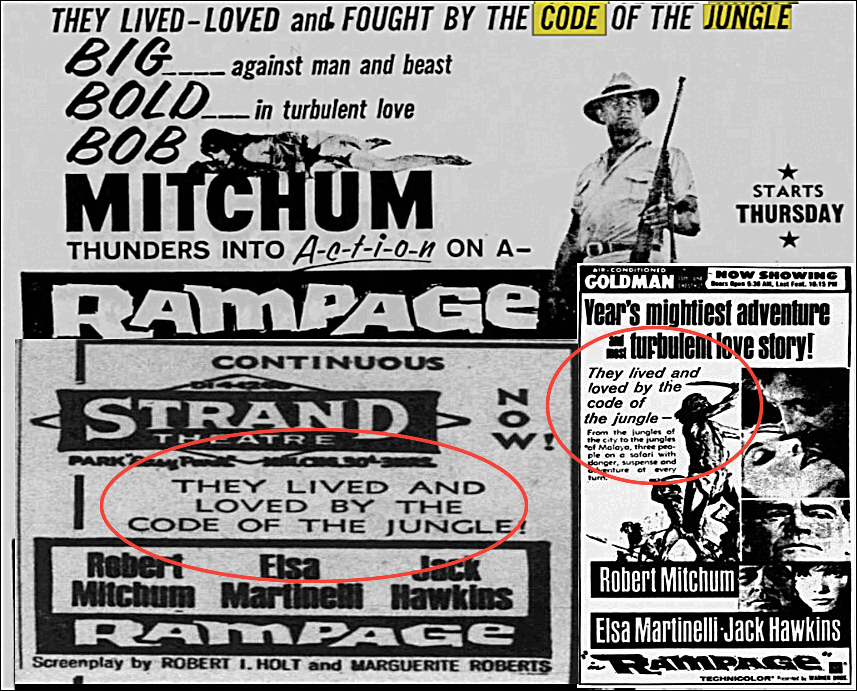
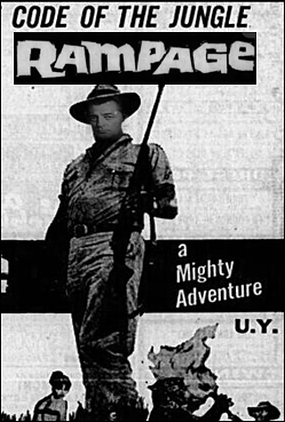
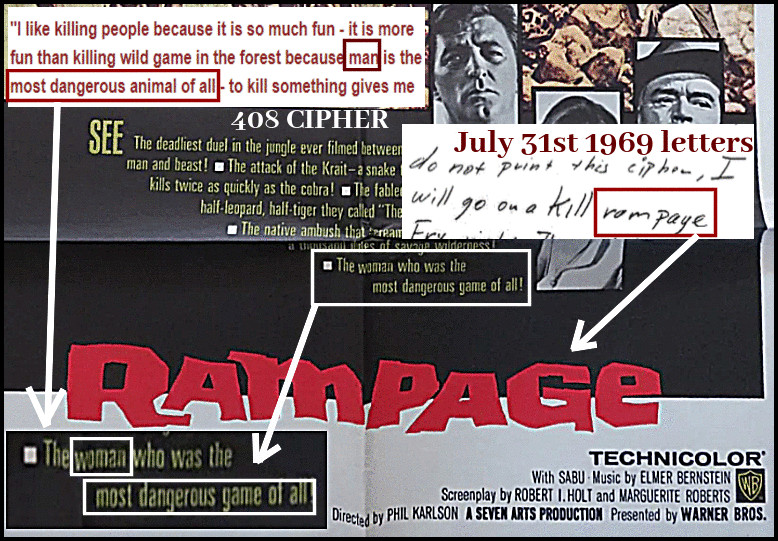
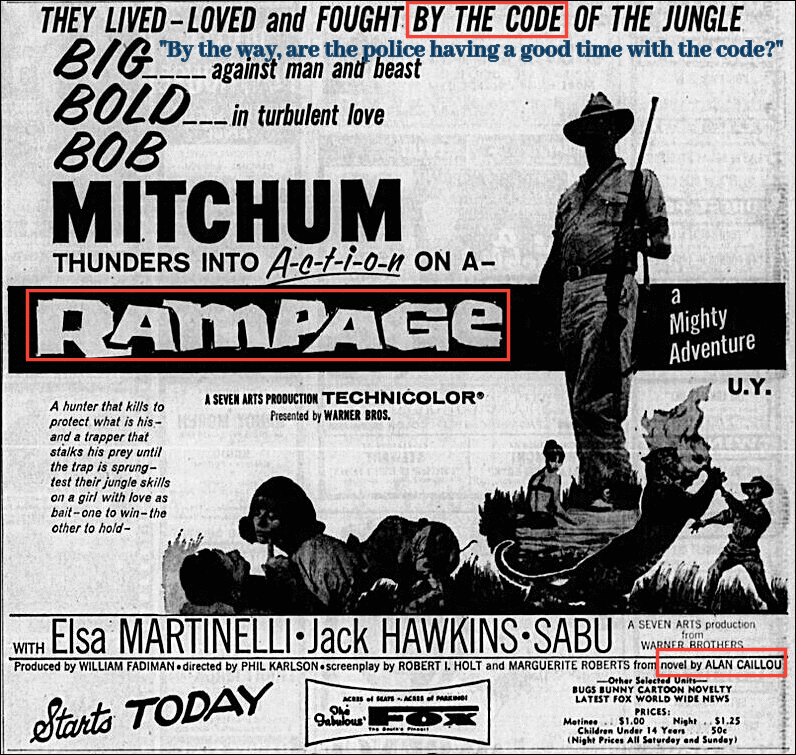
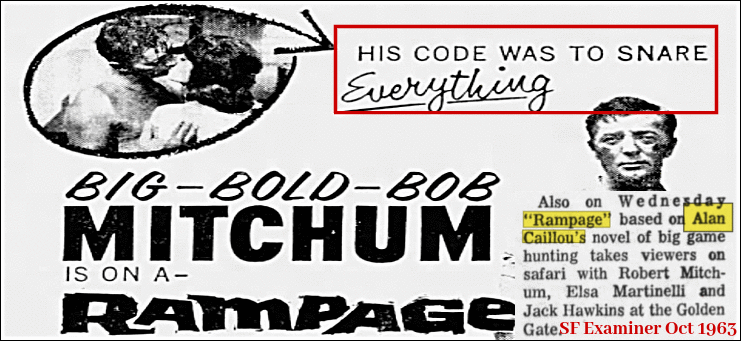
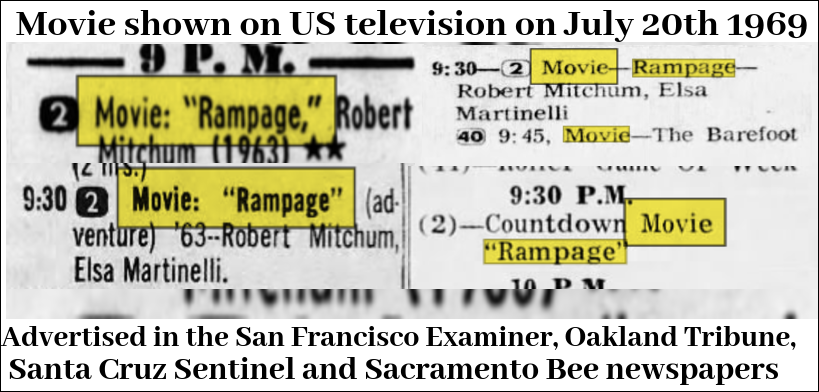
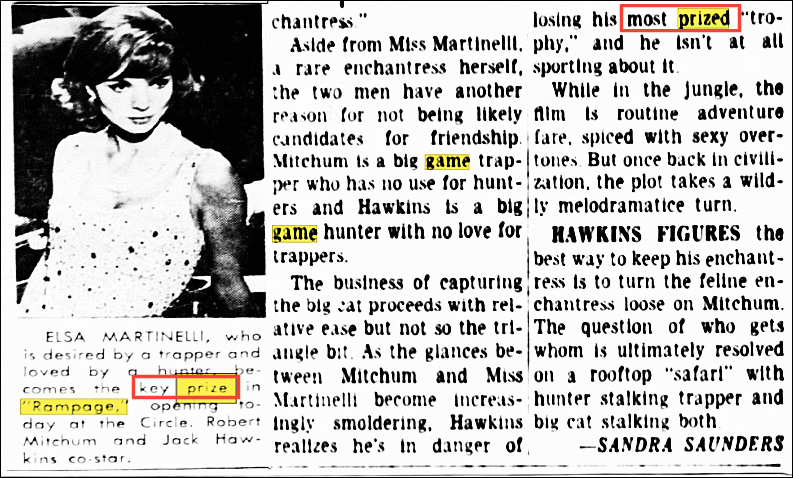
There is good argument to be had that the Zodiac Killer began the design of his July 31st 1969 letters and 408 cipher shortly after July 20th 1969, when the movie "Rampage" (1963), based loosely on "The Most Dangerous Game" (1932), was screened on television throughout the Bay Area. This was a film originally championed by movie posters, newspaper advertisements and the original Warner Brothers press book, carrying the slogans "The woman who was the most dangerous game of all", "The screen's mightiest excitements go on the rampage", "Big, Bold, Bob Mitchum is on a Rampage", "They lived, loved and fought by the code of the jungle" and "His code was to snare everything". It isn't difficult to see how the Zodiac Killer would then create a trinity of letters carrying the message that "man is the most dangerous animal of all" and that he would "go on a kill rampage". part enciphered within a code. This film, screened on American television just eleven days earlier, even had crosshairs featured in the opening credits of the movie. 

However, this movie was likely the inspiration for the Zodiac Killer to delve into the newspaper archives and conduct some research into the original film "The Most Dangerous Game" (1932), using tools such as library microfiche. I recreated this possible research and looked for the phrase "man is the most dangerous animal of all" from 1690 to 1969 and found only one result in 1932.

PicturePress-Enterprise newspaper, November 24th 1966
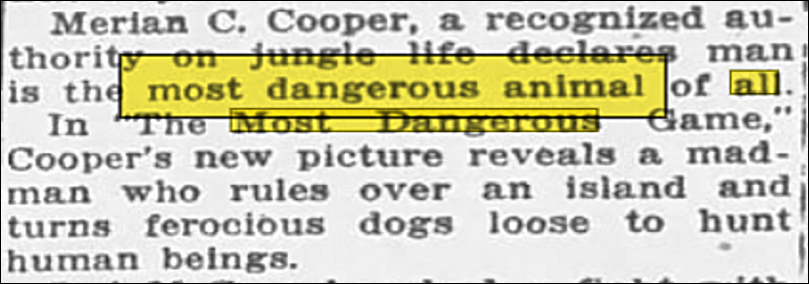
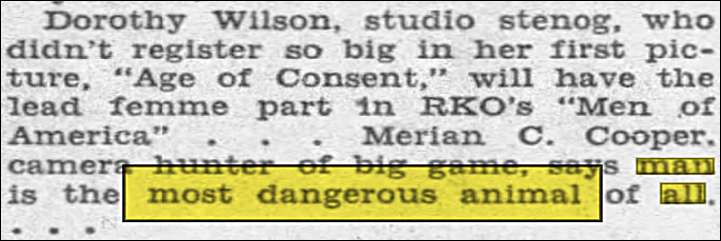
​Merian C. Cooper, the associate producer of "The Most Dangerous Game" was interviewed upon its release, and he was quoted as saying "man is the most dangerous animal of all". The Zodiac Killer had effectively plagiarized this quote and embedded it into his code. It turned out that Merian C. Cooper, an avid game hunter and explorer, had done something similar, taking the phrase from a quote by Frederick "Fritz" Joubert Duquesne, another game hunter. 

​Frederick "Fritz" Joubert Duquesne had previously stated that "The most dangerous animal of all to capture is the gorilla", that was likely picked up by Merian C. Cooper because he was working on the movie "King Kong" at the same time he was involved in the making of "The Most Dangerous Game". "King Kong" was directed and produced by Merian C. Cooper.

​Frederick "Fritz" Joubert Duquesne and Merian C. Cooper had both worked for RKO Pictures inside of one year from one another. The movie company behind both "The Most Dangerous Game" (1932) and "King Kong" (1933) was RKO Pictures.

It appears as though DNA and fingerprint analysis has failed to bridge the gap between Riverside and the Bay Area murders, as has analyzing the text of the Riverside communications to forge a conclusive link in language between southern and northern California. This left one final option: discovering a commonality in design between the lengthy Riverside Confession letter and the July 31st 1969 letters mailed to the San Francisco Chronicle, San Francisco Examiner and 
Vallejo Times-Herald. In other words, was there a recent trigger that caused the Confession letter author to delve into the library microfiche for suitable quotes from yesteryear? Long suspected to be based upon "The Most Dangerous Game" (1932), the 408 cipher author just happened to harvest the exact quote from its associate producer, spoken in 1932. What are the chances that the Confession letter author would find a equal length quote for his November 29th 1966 typed letter, harvested from the year of "Jack the Ripper" in 1888, after mimicking the wording from a recent newspaper article mentioning Cheri Jo Bates and "Jack the Ripper"? (see article clipping above).  

PictureMANY NEWSPAPERS, DEC 11TH 1888
The author of the Confession letter seemed to borrow phrases from The Press-Enterprise newspaper on November 24th 1966. The newspaper article generated in the above link stated that the man "grabbed her around the neck". The confession letter author typed "I grabbed her around the neck with my hand over her mouth". The newspaper article stated "I could just hit you in the head with this piece of wood". The confession letter author typed "She let out a scream once and I kicked her in the head to shut her up". Both the Confession letter author and the man featured in the above newspaper offered the woman a lift home. 
​

​After reading the newspaper article on November 24th 1966 quoting "Jack the Ripper", its easy to reconcile a Confession letter author typing "Ripper" like phrases such as "cut off her female parts and deposit them for the whole city to see", "finished the job out cutting her throat" and "I am stalking your girls now". Especially when the additional phrase of "it was about time for her to die", present in the Confession letter, could only be found in one newspaper article on December 11th 1888 (the year of "Jack the Ripper"), from newspaper archive searches spanning 1690 to 1966. December 11th 1888 being the same day it was reported that "Jack the Ripper" had possibly "cut the throat" of a woman on Bermondsey Street in London, causing great excitement in the neighborhood. 

Picture
  1. Here is the newspaper article entitled "The Sturdy Beggar" featured in the Evening Bulletin newspaper from Providence, Rhode Island on December 11th 1888. The attacker in this instance motioned towards a possible knife in his pocket and threatened that "it was about time for her to die", just like the Confession letter author who typed "I said it was about time for her to die. I grabbed her around the neck with my hand over her mouth and my other hand with a small knife at her throat". 
It was believed that "Jack the Ripper" would grab his victims around the neck before drawing the knife across their throat to prevent any screaming. A gruesome scenario exemplified by a Confession letter which undoubtedly rejoiced in the cruelty of murder. Who then promised to remove body parts and display them for the whole city to see. 

On July 31st 1969, we effectively have the Zodiac Killer using a quote from Merian C. Cooper, the associate producer of "The Most Dangerous Game" in 1932, only eleven days after the "Rampage" movie appeared on US television screens, that used a phrase based upon the Merian C. Cooper quote in its advertising. On November 29th 1966 we have an author commenting on the murder of Cheri Jo Bates, five days after a newspaper article featuring Cheri Jo Bates and "Jack the Ripper", using a quote from the "Jack the Ripper" era of 1888 in the form of 
"it was about time for her to die", and promising to "cut off her female parts and deposit them for the whole city to see". The Zodiac Killer and an unknown author using "man is the most dangerous animal of all" and "it was about time for her to die" from 1932 and 1888 respectively, less than two weeks after the "Rampage" (1963) movie and a "Jack the Ripper" quote in a newspaper article concerning Cheri Jo Bates. I find it difficult to believe in this many coincidences being accidental. This may be the product of one individual using the same technique in 1966 and 1969.  

Picture
As far as can be ascertained, it appears as though the white Chevrolet Impala described by Robert Connelly, Frank Gasser and Bingo Wesner in the Lake Herman Road police report never made it into the newspapers. This may have been held back to not encourage the driver of this vehicle to distance themself from it, as they attempted to track it down. However, subsequent to the second attack at Blue Rock Springs, the description of this vehicle, allied with the description of the man given by Michael Mageau, may have been useful in the public domain to gain assistance that was badly needed by police. Somebody may have known of an individual who had recently sold (or no longer drove) such a vehicle, had this person attempted to part company with the Chevrolet. A revised search could also have been done after Presidio Heights, when new descriptions of the killer were submitted by three sets of eyewitnesses within minutes of one another. 

This individual parked the Chevrolet Impala in the Lake Herman Road turnout sometime prior to 9pm and 10pm on December 20th 1968 and wandered off into the night, before returning. Had this been the Zodiac Killer hunting for victims in the adjoining fields, the description of a pencil flashlight mounted on a gun now doesn't seem so fanciful. Apart from the eyewitnesses in the police report, only the Zodiac Killer would have known of this vacant Chevrolet Impala (had it been his). In other words, the Zodiac Killer may have brought up the notion of gun-mounted illumination, because he knew the hunt for victims initially extended beyond the turnout perimeter. An additional source of illumination that wouldn't have been required had the Zodiac Killer arrived at the turnout shortly after 11pm and remained within the confines of the turnout throughout. His murder of David Faraday and Betty Lou Jensen could easily have been achieved in a similar manner to that used at Blue Rock Springs, employing the headlights from his vehicle and/or a handheld flashlight to illuminate his victims from close range. The use of a pencil flashlight buys into the notion of a hunter stalking the surrounding fields of Lake Herman, along with his use of the phrase "man is the most dangerous animal of all" in the 408 cipher, plagiarized from the words of two big game hunters in Merian C. Cooper and ​Frederick "Fritz" Joubert Duquesne, who both worked for RKO Pictures in the 1930s.

Picture
The vacant white Chevrolet Impala close to 9pm, and sometime after 10pm coincides with Robert Connelly and Frank Gasser hunting raccoons in the adjoining field, so this may explain why the owner of the Chevrolet Impala decided to abandon his plans for murder during this time period (to possibly target Bingo Wesner or another). The thought of encountering two hunters was probably something he hadn't bargained for, resulting in him leaving twice and arriving for a final time shortly after 11pm.

​This time he saw David Faraday and Betty Lou Jensen parked up in their Rambler, making any venture into the surrounding fields unnecessary. No wonder he wrote on August 4th 1969 "there was no need to use the gun sights.  All I had to do was spray them as if it was a water hose". There was never any need to use gun sights in the turnout - but for a hunter stalking his prey in the fields of Lake Herman at distance, having left his vehicle for a protracted length of time - the marksmanship provided by gun sights would have come in much more useful. A Zodiac Killer driving a 1959/1960 white Chevrolet Impala, that he was only too glad to concede was brown in the very same letter.  

"THE MOST DANGEROUS ANIMAL OF ALL" BY FREDERICK "FRITZ" JOUBERT DUQUESNE

12/29/2024

 
Picture
When interviewed about the release of the movie "The Most Dangerous Game" in 1932, its associate producer, Merian Caldwell Cooper (born 1893) replied "man is the most dangerous animal of all". Merian C. Cooper wasn't only known as a filmmaker, actor and producer, he was an officer with the United States Army Air Service and Polish Air Force, who began his fledgling movie career as part of the Explorers Club, traveling the world and thoroughly documenting his adventures.

As a young 6-year-old, he decided that he wanted to become an explorer after reading stories from the book "Explorations and Adventures in Equitorial Africa". Cooper would eventually realise those ambitions. He was also a big game hunter, so when the script for the upcoming movie "The Most Dangerous Game" was presented to him, it obviously appealed greatly to his penchant for adventure, detailing a psychotic big game hunter who deliberately strands a luxury yacht on a remote island, where he plans to hunt its passengers for sport. This movie title has been touted as the inspiration for the Zodiac Killer's wording in the 408 cipher, but it seems that the quote given by Merian C. Cooper to a reporter of "man is the most dangerous animal of all", was the likely origin for the Zodiac Killer's choice of words in his lengthy cryptogram. Something that he could only reasonably have found by trawling through microfiche reels in the library. Currently, I have only found this exact quote in three newspapers, all from America in 1932. 

PictureFrederick "Fritz" Joubert Duquesne
However, "The Most Dangerous Game" wasn't the pinnacle of his movie career, because in 1933 the much acclaimed movie "King Kong" was released by RKO Radio Pictures, directed and produced by Merian C. Cooper and Ernest B. Schoedsack. Cooper was inspired to create the character of King Kong, a giant ape, after developing a scenario for a “gorilla picture” in 1929. Cooper's original concept for the film involved a giant gorilla who kidnaps a woman, fights dragons, and is defeated by modern technology. His fascination for adventure and hunting would coalesce to produce a film praised by critics and the viewing public for its stop-motion animation and score.

​But did the conception of "King Kong" and his love of big game hunting play any part in his quotation of 
"man is the most dangerous animal of all"? There is a strong likelihood that the Zodiac Killer took this phrase from Merian C. Cooper, but did Cooper develop this phrase from somebody else before him? Somebody who was also an adventurer and big game hunter, who came face to face with a gorilla in Africa. An adventurer who would almost certainly have been known to Merian C, Cooper.  

To cover the story of Frederick "Fritz" Joubert Duquesne (born 1877) would take forever, so here is a condensed version of this infamous character, described as a soldier, big game hunter, journalist and spy, who fought with the Boers in the Second Boer War and as a secret agent for Germany during both World Wars, and became known as the man who killed Lord Kitchener, a British Army officer and colonial administrator. Duquesne was an advisor to US President Theodore Roosevelt on big-game hunting, as a publicist in the movie business, as a journalist, as a fictional Australian war hero and as head of the New Food Society in New York. As a youth, Duquesne became a hunter like his father. His hunting skills proved useful not only in the African landscape, but also later in life, when he would publish articles about and give lectures on big-game hunting. Below is a newspaper cutting from 1912 describing one of Roosevelt's hunts in Africa, with the sub-headline "The First Hunt for Buffalo, the Most Dangerous Game in Africa". In numerous statewide articles in America throughout the years, Frederick Duquesne was featured in countless stories, including full page spreads on big-game hunting.​ One of which we'll get to soon.

Picture
Picture
During the Second Boer War, Duquesne was under orders to assassinate Frederick Russell Burnham, the American acting as Chief of Scouts for the British Army. After the war, Burnham remained active in counter-espionage for the British, and much of it involved keeping track of Duquesne. In 1910 he and Representative Robert Broussard founded the New Food Supply Society to import useful African wildlife into the US as a solution to a serious American meat shortage, and Broussard selected Duquesne as an expert. In support of this plan, Broussard introduced H.R. 23261, also known as the American Hippo Bill, attempting the appropriation of $250,000 to import hippopotamus into the Louisiana bayous as a food source and to control the water hyacinth then clogging Southern river systems. Former US President Theodore Roosevelt backed the plan, as did the US Department of Agriculture, as well as editorial writers in The Washington Post and The New York Times, which praised the taste of hippopotamus as "lake cow bacon". Duquesne's expert testimony on this subject before the House Committee on Agriculture is recorded in the Congressional Record. The bill fell just short of passing, and the New Foods organization was disbanded. Wikipedia. 

Picture
​Duquesne was wanted by His Majesy's government for murder on the high seas, but fled to Mexico and Europe. In 1926 he moved back to New York and assumed a new identity as Frank de Trafford Craven. He worked for Joseph P. Kennedy's Film Booking Offices of America (FBO Pictures), and later RKO Pictures in 1928, as part of the publicity staff. As part of this job he moved back to Manhattan, where he was well-known under his real name. In 1930, Duquesne moved to the Quigley Publishing Company, a producer of movie magazines, and called himself Major Craven. This is just the tip of the iceberg, so if you want to read the rest of his life story, click here.

​Both Merian C. Cooper and Fredeick Duquesne worked for RKO Pictures, with Cooper joining RKO Pictures in 1931, just before the release of "The Most Dangerous Game" (1932) and "King Kong" (1933). With their common lifelong interest in adventure and big-game hunting, and both employed by RKO Pictures during a similar time period, it is not difficult to see how Merian C. Cooper came upon the words 
"man is the most dangerous animal of all". In one of Frederick Duquesne's many ventures into Africa, he spoke of a "Blood Curdling Gorilla Hunt" in 1909 that was covered extensively in US newspapers, stating that "The most dangerous animal of all to capture is the gorilla". 

​
The filming for "The Most Dangerous Game" and "King Kong" by RKO Pictures overlapped in 1932, so it can be strongly argued that Merian C. Cooper took the quote of "The most dangerous animal of all to capture is the gorilla" from Duquesne, and during the filming of "King Kong" he repackaged it to read ​"man is the most dangerous animal of all" to fit the narrative of "The Most Dangerous Game", which replaced hunting animals with the hunting of humans. So the phraseology of the Zodiac Killer in his 408 cipher on July 31st 1969 may have its roots as far back as 1909 in the words of Frederick "Fritz" Joubert Duquesne. The Zodiac Killer's wording of "I like killing people because it is so much fun, it is more fun than killing wild game in the forest because man is the most dangerous animal of all", now makes a lot more sense. His claim of using a pencil flashlight on his gun on August 4th 1969 so he could hunt victims, is in keeping with his trinity of letters to the San Francisco Chronicle, San Francisco Examiner and Vallejo Times-Herald.

Picture
​Anybody reading the numerous Lake Herman Road newspaper articles would have been aware that one eyewitness reported seeing a second vehicle in the turnout with the Faraday Rambler, but nobody would have been aware of the empty Chevrolet Impala parked in the turnout at 9pm and 10pm on December 20th 1968, except the police and each of the eyewitnesses that night - and probably the killer. If the occupant of this vehicle had traveled into the adjoining fields on two occasions, looking for victims, they would have required additional illumination such as a carry flashlight or gun-mounted flaslight.

If this was the murderer's vehicle he would have known this. Therefore, the claims of the August 4th 1969 letter writer stating that he used a pencil flashlight for extra illumination is extremely noteworthy. Extra illumination would not have been required in the turnout when you have the use of headlights from your vehicle, along with the illumination from within each vehicle. Also, extra illumination would certainly not have been required if the murderer had kept the couple penned inside their vehicle. The only person that would have required additional illumination (either carried or gun-mounted) would have been somebody venturing into the fields surrounding the turnout. Such as the driver of the white Chevrolet Impala, who apparently never came forward. ​There is a distinct possibility that this Chevrolet owner wrote the "Debut of Zodiac" letter, because this person had a viable reason to carry additional illumination as he distanced himself from his vehicle that night. Not once, but twice, on a freezing dark night in Benicia. Possibly an individual, who on July 31st 1969, would promote the idea of hunting humans in the wilderness because it was more fun than killing wild game in the forest. 

Picture
NEW YORK EVENING JOURNAL, MAY 24TH 1932

"A GAME OF DEATH" IN RIVERSIDE

5/9/2024

 
PictureJohn Loder starred as Don Rainsford
When "The Most Dangerous Game" movie was released in 1932, its associate producer, Merian C. Cooper, reflected on the evil of the human condition and stated "man is the most dangerous animal of all". This would be the wording used by the Zodiac Killer in his decrypted 408 cipher, solved by Donald and Bettye June Harden on August 8th 1969. Thirteen years after "The Most Dangerous Game" was released, "A Game of Death" starring John Loder and Audrey Long opened in US cinemas on November 23rd 1945. A poor remake of the original, the only real difference was that the evil Russian, Count Zaroff, had turned into the insane German, Erich Kreiger.

​This later movie featured on television throughout California from November 5th 1966 to November 8th 1966 - so if the Zodiac Killer was present in Riverside (or California) during this period, and was responsible for any of the communications down south - could this movie have had any influence on the phrases chosen in the Confession letters? Did the flawed character traits of Count Z
aroff and Erich Kreiger, who were insane, heartless, and psychopathic men with a thirst to hunt human beings, form the basis of the wording "I am insane. But that will not stop the game" in the Confession letters on November 29th 1966? That "game" being "a game of death", in which the insanity of Erich Kreiger and the Confession letter author created no barrier to the murderous game and ambitions of either.. "A Game of Death" in 1966 turning into a "Most Dangerous Game" in the Bay Area, two to three years later. The murders in southern and northern California cloaked under the banner of the Richard Connell short story of 1924. 

The film Rampage (1963) borrowed elements of "The Most Dangerous Game", including 
"The woman who was the most dangerous game of all", while using "Big, Bold, Bob Mitchum is on a Rampage" in its promotional advertisements, along with "They lived, loved and fought by the code of the jungle" and "His code was to snare everything". Bearing in mind the choice of words used by the Zodiac Killer in his code and letters on July 31st 1969, coupled with the crosshairs he adopted, which featured in the opening sequence of the "Rampage" movie, this production had many interesting parallels and appeared on US television screens in California just 11 days prior to Zodiac's opening communications. "A Game of Death" was showing in California three weeks before the typed Confession letters arrived at the Riverside Homicide Detail and Riverside Press Enterprise in 1966.

Picture
The Riverside Desktop Poem, Confession letters and "Bates Had to Die" letters had a consistency of language that permeated all three, shown in this article (and the image below). Another point of interest, is that all three communications ended in similar fashion. The Riverside Desktop Poem finished with "Just wait till next time", the two Confession letters finished with "Beware....I am stalking your girls now", and the Bates' letters finished with "there will be more". All three, by implication, promising death in the near future. These Riverside communications had a consistency of menace and language, but they were all fashioned in markedly contrasting ways. One was written on a desktop in blue ballpoint pen (for the most part) in lower case handwriting. Both Confession letters were typed (with the envelopes in capital letters), and the Bates' letters were written in, what can only described as scrawl (with no consistency). One could argue that if all of these communications were authored by one person, then they had deliberately manufactured them with such difference of design, so as to disguise this fact to the reader. If deception was their intention, I would argue that they failed miserably because of the similarity of language that flowed from one to the other.  

"The Most Dangerous Game"
 heavily focused on a tense stalking sequence in the second half of the movie as Rainsford and Eve attempted to outwit Count Zaroff as he tracked them while wielding his prized Tatar war bow. The 1945 film mimics the original for the most part. Therefore, is it a coincidence that after the Confession letter stated "I am insane. But that will not stop the game", it concluded with "I am stalking your girls now". It appeared that the "game" was stalking women as prey. This stalking would seemingly continue on July 31st 1969, when the Zodiac Killer began with "I like killing people because it is so much fun - it is more fun than killing wild game in the forest because man is the most dangerous animal of all". Was the game employed by the Zodiac Killer, at least in a literary sense, continuing after 32 months? Was the Zodiac Killer operating in Riverside in 1966 (at least with his communications), or was he simply incorporating the story of Riverside into his current campaign of terror in the Bay Area of northern California?  
​
ADDITIONAL READING: RETHINKING "THE MOST DANGEROUS GAME" 
Picture
Picture

MERIAN C. COOPER AND "THE MOST DANGEROUS GAME" (1932)

4/23/2024

 
PictureMerian C. Cooper
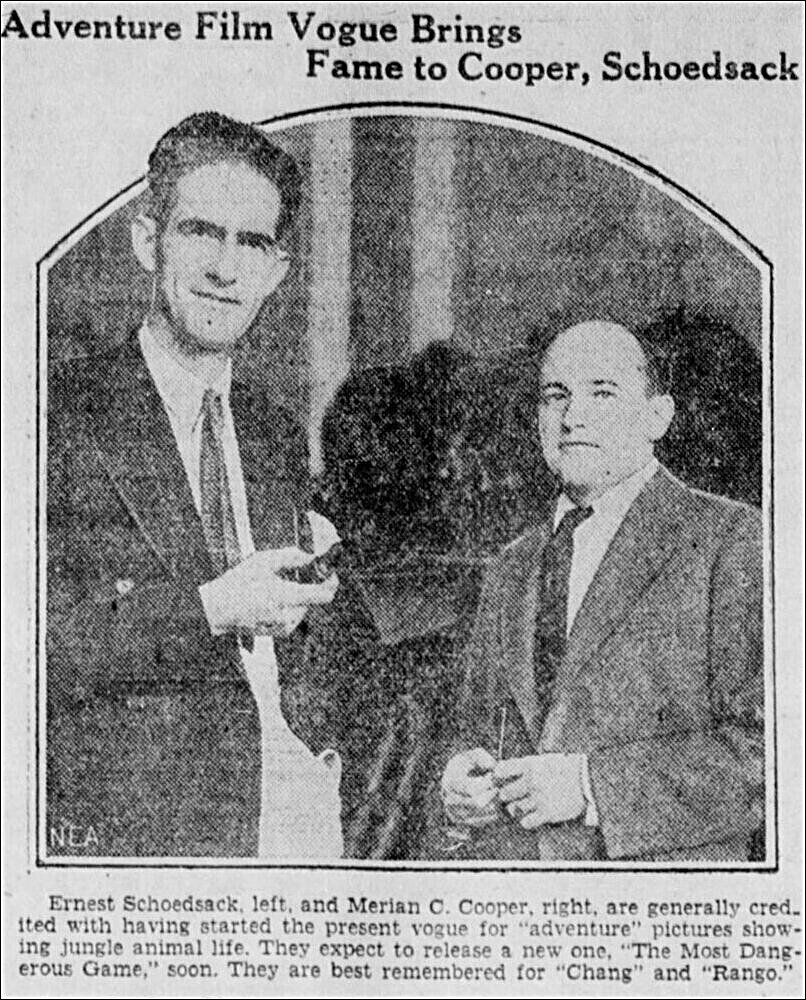
It is far too simplistic to make the jump from the phrase "man is the most dangerous animal of all" from the 408 cipher to "The Most Dangerous Game" short story by Richard Connell (1924) and/or the film version by RKO Radio Pictures (1932). The phrase "man is the most dangerous animal of all" stands alone in its own right as an utterance by Merian C. Cooper, a filmmaker, actor and producer, recognized as an authority on jungle life. The overwhelming majority of his films gracing our screens were produced in the first half of the 20th century, including King Kong (1933), in which he was both director and producer during its making throughout 1932. This project ran alongside the release of "The Most Dangerous Game" (1932), to which he was the associate producer.

Upon release of "The Most Dangerous Game" he declared that "man is the most dangerous animal of all", because the movie featured a madman who switched from hunting animals to hunting humans on a remote island. This was the origin phrase used by the Zodiac Killer when he mailed the first part of the 408 cryptogram to the Vallejo Times-Herald on July 31st 1969. Therefore, the loose translation from "The Most Dangerous Game" to "The Most Dangerous Animal" was in fact correct, because of the below quotation by Merian C. Cooper about the movie in the newspapers. It stated "Merian C. Cooper, a recognized authority on jungle life declares man is the most dangerous animal of all".

Picture
Picture
A young Zodiac fascinated by movies would have had ample opportunities to watch adventure films such as Rango, The Most Dangerous Game and King Kong during his formative years. However, this word-for-word mimicking of "man is the most dangerous animal of all" in his 408 cipher - one would have thought - likely came from something more contemporary which reminded him of its origins.

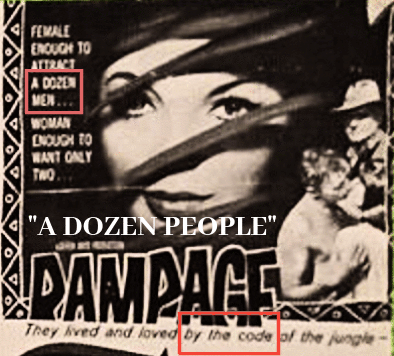
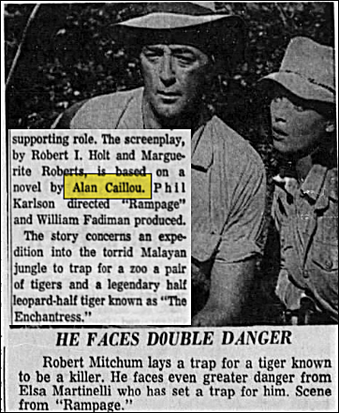
Recently it was shown that the 1963 movie "Rampage" had all those ingredients, including the phrases "The woman who was the most dangerous game of all" (man is the most dangerous animal of all), "go on the rampage" (go on a kill rampage), "a dozen men" (a dozen people) and the crosshairs over the movie title during the opening credits of the movie. The book "Rampage" by Alan Caillou, the movie poster and original Warner Brothers press book cover, along with the newspapers, contained numerous references to these phrases. It was also ironic that the phrase "man is the most dangerous animal of all" would be placed by the Zodiac Killer within a code, when statewide, the "Rampage" movie would be advertised in the newspapers under the wording "They lived, loved and fought by the code of the jungle" [1] and "His code was to snare everything" [2].. The movie "Rampage" was broadcast on US television on July 20th 1969 (Channel 2), 11 days before the July 31st 1969 letters were mailed by the Zodiac Killer - with the movie advertised in the San Francisco Examiner, Sacramento Bee, Oakland Tribune, Berkeley Gazette and Santa Cruz Sentinel, to name just a few. To read the full story click here.
Picture
The original phraseology of "man is the most dangerous animal of all" was born from the movie "The Most Dangerous Game" through Merian C. Cooper in 1932, but the additional phrases mentioned above (including the crosshairs and code) used by the Zodiac Killer on July 31st 1969, may have been inspired by the more contemporary movie "Rampage" (1963). It seems that both may have played a role in the theatrics of the Zodiac Killer.  
Picture

TO THE SLAUGHTER LIKE A LAMB

4/6/2024

 
Picture
One of the long-standing questions in the Zodiac community is whether a solid link can be forged between the Riverside murder of Cheri Jo Bates and/or the associated communications in 1966 and 1967, with the crimes or letters of the Zodiac Killer, beginning on December 20th 1968. On April 30th 1967, somebody mailed three letters to the Riverside Press-Enterprise, Riverside Police Department and Joseph Bates stating "She had to die. There will be more" and "Bates had to die. There will be more".

​This approach would be somewhat mimicked by the Zodiac Killer on July 31st 1969 (without the 1967 Bates letters currently published), who mailed three letters to the San Francisco Chronicle, San Francisco Examiner and Vallejo Times-Herald with his hidden cryptographic message of "the best part of it is that when I die I will be reborn in paradise and all the I have killed will become my slaves". One individual had already used the phrase "to die" in the Riverside Desktop Poem, Confession letters and Bates letters (six times), so looking at the transition from "she had to die" to "when I die" from Riverside to the Bay Area, it is certainly worth looking into further. Especially when you consider the fact that the Zodiac Killer never used the word "die" in any of his subsequent communications.    

Also noteworthy, but not compelling, was the continuation in the religious overtones of "The Confession" letter and "She went to the slaughter like a lamb. She did not put up a struggle", to the message of the Zodiac Killer in the 408 cryptogram, in which he enciphered the wording "paradice", "reborn" and "afterlife" with respect to his death (when I die). The saying, "Like sheep to the slaughter", was used in respect to the notion of Jewish people being led passively to their deaths during the Holocaust. In other words, the suggestion that they offered no resistance or struggle - to be articulated by "The Confession" letter author when they typed "She (Bates) did not put up a struggle". and "She went very willingly". Cheri Jo Bates, it was claimed, was being marched passively to her death.       

Picture
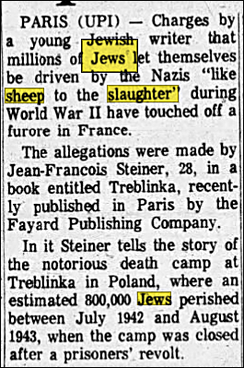
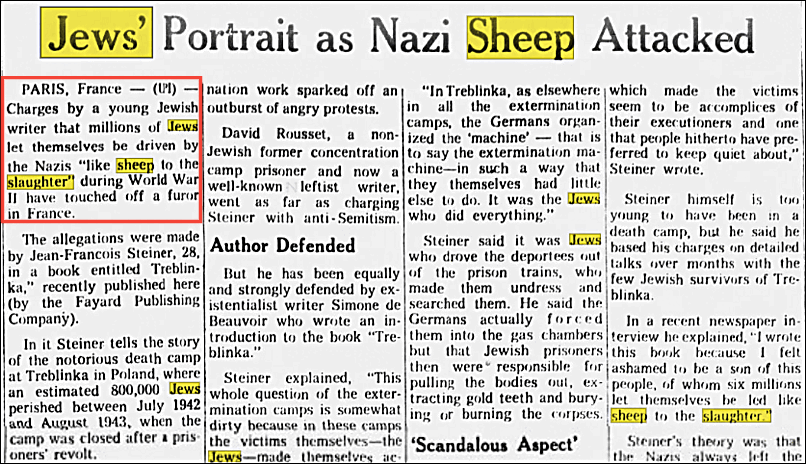
Just a few months before the November 29th 1966 "Confession" letter, Jean-François Steiner released a highly controversial book entitled Treblinka: The Revolt of an Extermination Camp, claiming that the Jews were led "like sheep to the slaughter" - and in doing so - caused worldwide consternation in the newspapers. Although Steiner was not the originator of the phrase, it nevertheless was contemporary to 1966 to anybody who was well-versed in literature or recent newspaper coverage. If the author of the 1966 Riverside Desktop Poem can borrow headlines from The Press and Daily Enterprise on April 17th 1965 entitled "Clean-cut Youth Sought In Stabbing", then they can do the same in the case of the Jean Francois Steiner story. Changing "sheep to the slaughter" into "slaughter like a lamb".

In Isaiah 53, a chapter in the Hebrew Bible tells of a virtuous servant who is murdered but does not protest: "Like a sheep being led to the slaughter or a lamb that is silent before her shearers, he did not open his mouth". The Confession letter author typed "I grabbed her around the neck with my hand over her mouth and my other hand with a small knife at her throat. She went very willingly". There appears a mix of religiosity with contemporary news in the Confession letter, but it still isn't compelling. 

Picture
The Minneapolis Star Thursday, 12th May 1966
A link to Alfred Hitchcock and the Lake Herman Road murders of David Faraday and Betty Lou Jensen on December 20th 1968 has been suggested by Zodiac researchers, who highlighted the 1961 episode of the television series Alfred Hitchcock Presents, entitled Museum Piece. Aired on April 4th 1961, it featured an individual who used a light attached to his .22 caliber rifle in the commission of a murder, just as the Zodiac Killer had claimed in his follow up to the July 31st 1969 letters. The father of the convicted killer appealed to the district attorney about his son's innocence, which was rejected. The district attorney is then murdered - to which the father latterly reminisced “I remember the excitement of the manhunt. The most dangerous game”. Three years earlier, on April 13th 1958, Alfred Hitchcock Presents released an episode entitled "Lamb to the Slaughter", which was not that dissimilar to the phrase "to the slaughter like a lamb" used in the Confession letter. These observations ultimately fail to cement a link between Riverside and the Zodiac Killer, but the definitive answers we seek may still be found one day. 

THE SUFFERING MOTHER REBORN INTO PARADISE

2/1/2024

 
PictureSan Francisco Examiner, October 4th 1964
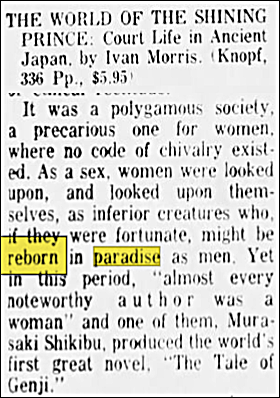
Not convinced that a previous observation of the Adventures in Paradise television series played a role in the Zodiac Killer's choice of words in the 408 cryptogram, I began looking for more contemporary offerings from a religious aspect, in respect to the phrase "reborn in paradise". Bearing in mind that the Zodiac Killer, in two letters, paraphrased three acts from The Mikado, a comic opera set in Japan, and used Japanese style symbolism at the foot of the Exorcist letter, it had to be a possibility that "reborn in paradise" was a product of Japanese history.

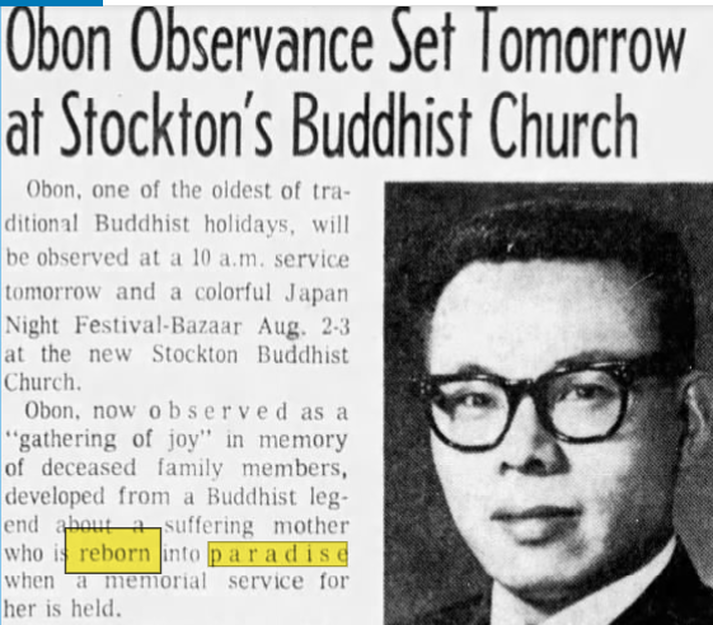
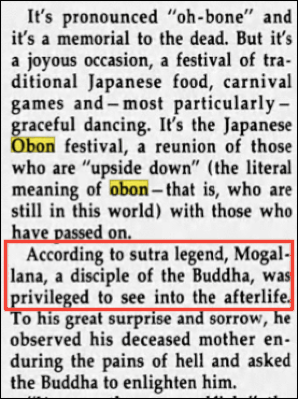
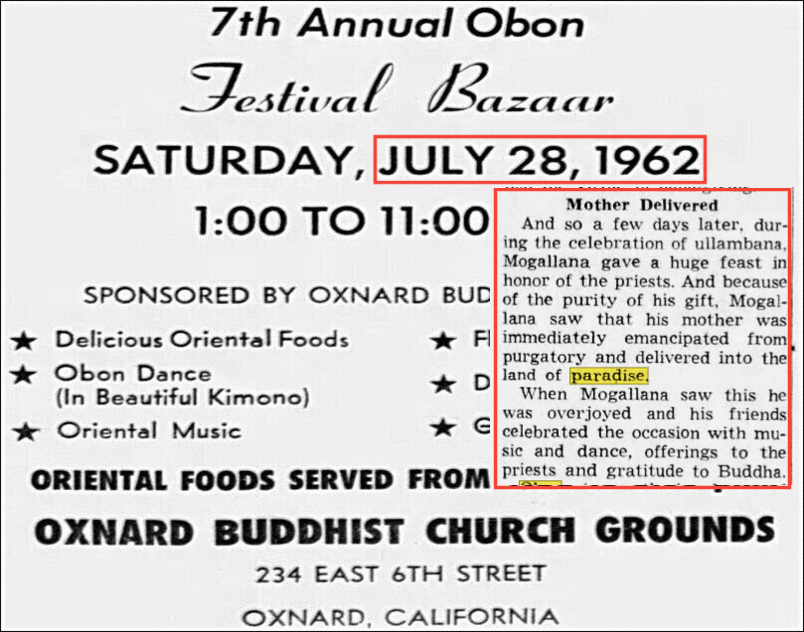
If the Zodiac Killer had a leaning towards Japanese culture, was he aware of the annual Obon festival, which is observed from the 13th to the 15th day of the 7th month. However, because of differences in the solar and lunar calendar, the 7th month is either July or August. Obon is therefore celebrated at different times in different regions, on and between these dates. This can be seen in the July 26th 1969 Stockton and Evening Record newspaper shown below, where the Buddhist holiday, born from the legend of a suffering mother "reborn into paradise", was held on August 2nd and 3rd - beginning the day after the Zodiac Killer's 408 cipher carrying the phrase "reborn in paradise" arrived at three newspapers. The Zodiac Killer's 408 cipher was mailed between July 15th and August 15th 1969, with its conception likely earlier. 

Picture
Stockton and Evening Record newspaper
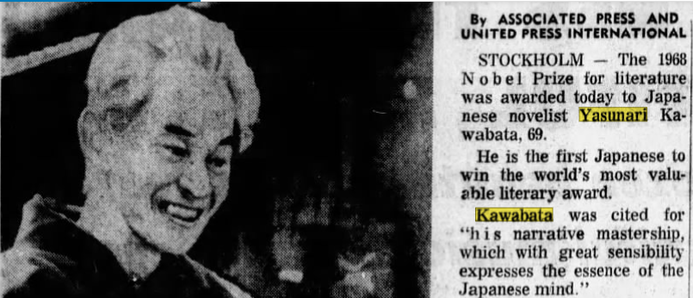
If the Zodiac Killer's life and/or thought processes were shaped by Japanese influences, then he would have had an interest in any newspaper or television coverage pertaining to this subject. It was previously shown how the Zodiac Killer's letters mailed on January 29th 1974, April 24th 1978 and May 2nd 1978 were heavily influenced by the Golden Globe and Academy Award ceremonies, so could the Bay Area murderer have been triggered by any recent event he had read or watched on television, that kept the phrase "reborn in paradise" in the forefront of his mind? Could he have created the 408 cipher shortly after the murders of David Faraday and Betty Lou Jensen on December 20th 1968 and added the accompanying text after his second attack on July 4th/5th 1969? On October 17th 1968, Yasunari Kawabata became the first Japanese writer to receive the Nobel Prize for Literature, before giving a Nobel lecture on December 12th 1968 entitled "Japan, the Beautiful and Myself". In part of his speech he stated "If Buddhism is divided generally into the sects that believe in salvation by faith and those that believe in salvation by one's own efforts, then of course there must be such violent utterances in Zen, which insists upon salvation by one's own efforts. On the other side, the side of salvation by faith, Shinran, the founder of the Shin sect, once said: "The good shall be reborn in paradise, and how much more shall it be so with the bad". This view of things has something in common with Ikkyu's world of the Buddha and world of the devil".
Picture
San Francisco Examiner, October 17th 1968
PictureLos Angeles Times
The following is taken from Palladiummag.com:: "The world of medieval Japan was one of division. The Emperor was, in practice, a distant memory; the shoguns had lost all control over their vassals. Even shrines and temples, once united in strengthening the state through prayer and ritual, now competed for believers and alms. Japan was divided against itself and circumstances forced its inhabitants to form new bonds to survive.

​Among the new alliances which this age produced were the Ikkō-ikki, a network of autonomous religious collectives that led major uprisings and controlled significant parts of Japanese society for nearly a century. Their final defeat at the hands of Japan’s warrior class set the stage both for a centralized Japanese state and the social hierarchy behind it. 
Nobunaga, head of the powerful Oda clan, conquered the capital city of Kyoto in 1568. In the years that followed, he made clear his intention to destroy the Honganji sect. The Patriarch Kennyo took him at his word and summoned all Ikkō-ikki from across the country to defend the faith with their lives. Despite graver circumstances than those faced by his predecessor Shonyo, Kennyo did not go as far as implying that those who fought for the Amida Buddha would be guaranteed rebirth in the Pure Land. Nevertheless, he threatened expulsion from the sect for those who failed to respond to the call and he did not crack down on those who raised the Ikkō-ikki’s now-famous banner of war: “Advance and be reborn in Paradise, retreat and fall immediately into Hell.”

These are just a few examples showing how a Zodiac Killer well-versed in Japanese culture could have taken "reborn in paradise" and used it in his 408 cipher on July 31st 1969, during the Obon featival that spanned this date. The religious connotations of "reborn in paradise" clearly came from somewhere - which may have subconsciously leaked into his early writings - and so reinforced the notion that The Mikado was a true passion of the Zodiac Killer.

Picture
Ventura County Star, July 26th 1962

THE AUTHOR OF RAMPAGE IN PARADISE

1/30/2024

 
Picture
Alan Samuel Lyle-Smythe MBE, M.C. (November 9th 1914 – October 1st 2006), who wrote his books under the pseudonym Alan Caillou, was an English-born author, actor, screenwriter, soldier, policeman and professional hunter. Recently I showed how the Rampage (1963) movie starring Robert Mitchum, Jack Hawkins and Elsa Martinelli was the primary influence behind the Zodiac Killer's July 31st 1969 letters and 408 cryptogram, not The Most Dangerous Game movie and short story, that has been put forward as the main driver for many decades.

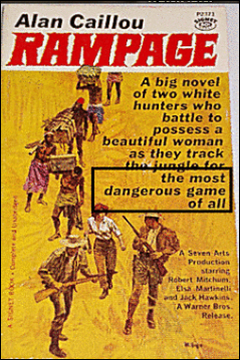
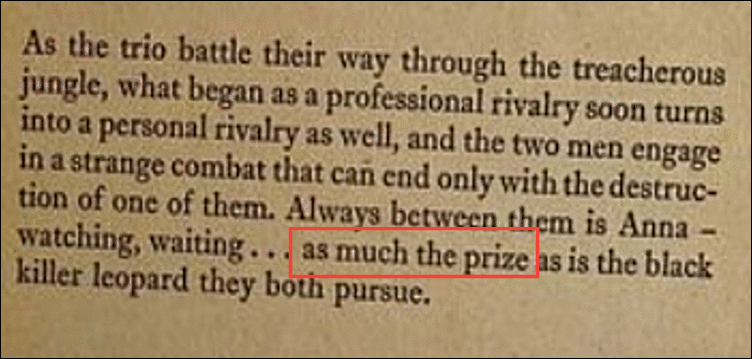
The Rampage movie was based upon a 1961 novel by Alan Caillou, which carried on its front cover the following text:
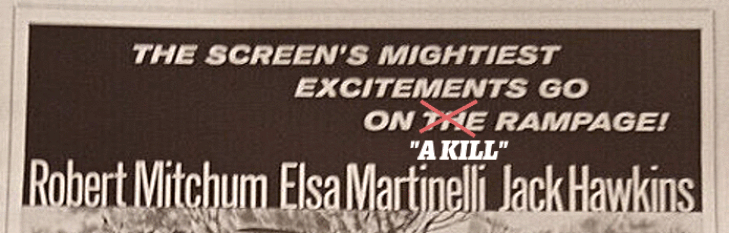
"A big novel of two white hunters who battle to possess a beautiful woman as they track the jungle for the most dangerous game of all". Converted by the Zodiac Killer into "the most dangerous animal of all". The Rampage movie poster and original Warner Brothers press book cover expanded the wording on the front of the Rampage book to "The woman who was the most dangerous game of all", which shaped the complete phrase used by the Zodiac Killer, when he enciphered "man is the most dangerous animal of all". The movie poster and Warner Brothers press book cover were also headlined by the words "The screen's mightiest excitements go on the rampage", with the Zodiac Killer threatening to "go on a kill rampage" in all three letters to the San Francisco Chronicle, San Francisco Examiner and Vallejo Times-Herald on July 31st 1969. The movie poster of "go on the rampage" differing only slightly to the Zodiac Killer's wording, when he wrote "go on a kill rampage". The opening credits of the Rampage movie also contained crosshairs embedded within its title. The feature article entitled "Rethinking The Most Dangerous Game" has many more connections between the July 31st letters and the Rampage book and movie, including the wording on another Zodiac letter (and cryptogram) in 1971.  

Picture
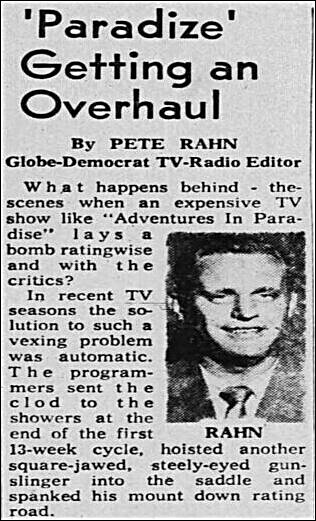
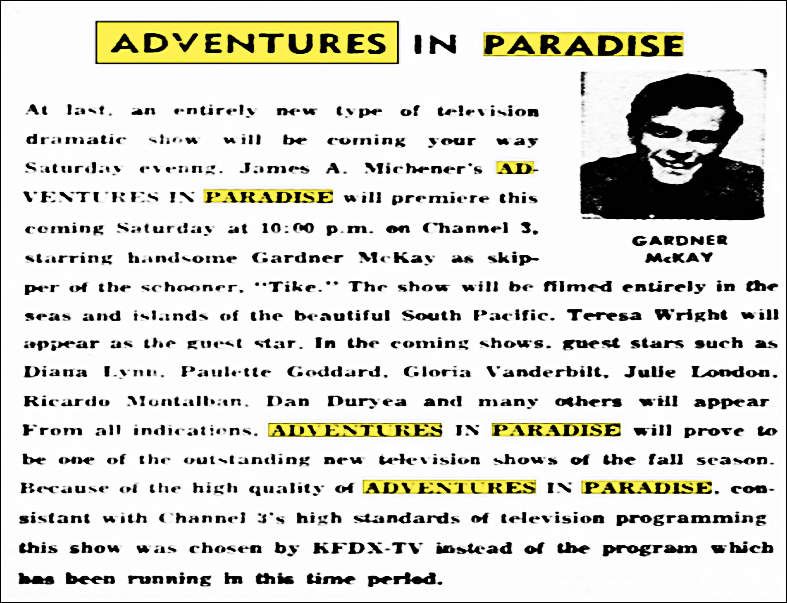
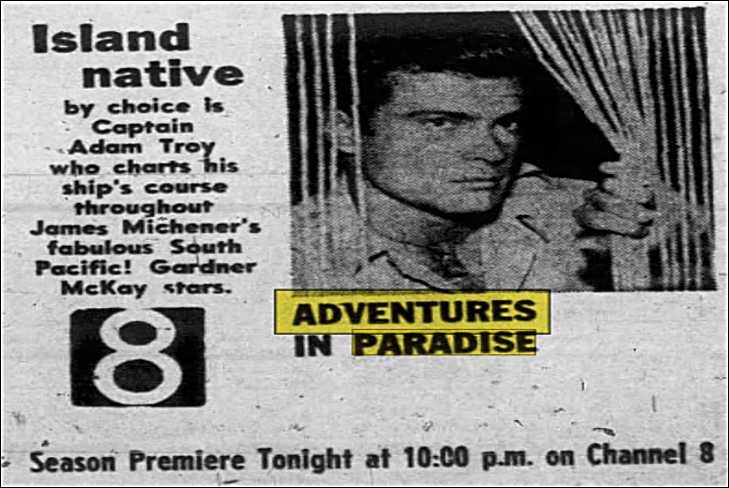
The one thing I couldn't connect between the book, movie and July 31st 1969 letters, was the Zodiac Killer's choice of the words "in paradise" in his 408 cryptogram (albeit misspelled). But if I was correct, the answer would be found in either the book, the movie, or Alan Caillou himself - sometime during this period. The Rampage book was released in several versions of paperback and hardback between January 1961 and 1963, during which time, Alan Caillou was starring in an extremely popular TV series created by James A. Michener (USA) that ran for 91 episodes between 1959 and 1962. The TV series was called Adventures in Paradise, described on the Internet Movie Database as the adventures of the Tiki III and crew as they sailed from island to island through the South Pacific, carrying cargo and the odd passenger from one drama to another. Alan Caillou starred in Incident in Suva (December 26th 1960) and Errand of Mercy (May 25th 1961). Alan Caillou played the characters "Bates" and "Inspector Black" in the series.  

Therefore, we have a 1963 movie that is more contemporary to the Zodiac murders, carrying the elements of "go on the rampage" (go on a kill rampage), "the most dangerous game of all" (the most dangerous animal of all), and the "crosshairs" in the movie title. ​The Warner Brothers press book also carried the phrase "a dozen men" (a dozen people), and "they lived and loved by the code", which the Zodiac Killer enquired about on August 4th 1969, when he stated "are the police having a good time with the code". We now have the author of Rampage starring in Adventures in Paradise at the same time. James A. Michener also created the movie Return to Paradise in 1953, starring Gary Cooper.

Picture
Picture

RETHINKING "THE MOST DANGEROUS GAME"
1/23/2024

 
Picture
​It has long been believed that the 1924 "The Most Dangerous Game" short story and/or 1932 RKO movie were the primary inspiration for the Zodiac Killer's three July 31st 1969 letters and his 408 cipher, beginning "I like killing people because it is so much fun - it is more fun than killing wild game in the forest because man is the most dangerous animal of all". Although "The Most Dangerous Game" had importance by being the predecessor that later movies borrowed from - with the film's associate producer, Merian C. Cooper, quoted as saying "man is the most dangerous animal of all" at the time of its release - I will present two more contemporary movies about "hunting" that probably had a bigger contribution in initially triggering and shaping the early Zodiac Killer correspondence. The first movie called "Rampage" (1963), about hunting in the dense forest of Malaysia, had all the ingredients for the design of the Zodiac Killer's July 31st 1969 offerings. The movie, starring Robert Mitchum, Jack Hawkins and Elsa Martinelli, features Harry Stanton (played by Mitchum) who prefers to hunt wild game without killing the animals, leading to conflict with the character Otto Abbot (played by Hawkins). 

Many Zodiac researchers believe the Zodiac Killer was influenced by the movies, so I wondered whether the Zodiac Killer borrowed the movie title "Rampage" when writing his threats to "kill a dozen people over the weekend", stating "
If you do not print this cipher, I will go on a kill rampage Fry night. This will last the whole weekend, I will cruse around killing people who are alone at night untill Sun Night or untill I kill a dozen people". 

Picture
​This on its own seems pretty weak, until you consider the crosshairs over the movie title during the opening credits of the movie, and the wording on the movie poster (and original Warner Brothers press book cover). The Zodiac Killer used the phrase "man is the most dangerous animal of all" in his decoded 408 cipher, while the movie poster (and press book cover) carried the wording "The woman who was the most dangerous game of all". One could argue that the Zodiac Killer used part of the word "woman" to create "man", and changed "the most dangerous game of all" to "the most dangerous animal of all". But it's possible that the Zodiac Killer saw or read about this movie first, and then found "The Most Dangerous Game" in the newspaper archives. Other than the Zodiac Killer in his 408 cipher, the quote  "man is the most dangerous animal of all" can only be found  in a handful of newspaper publications. Currently I have only found this quote from the movie's assocate producer three times - and all were in 1932 - thirty-seven years prior to the trinity of letters on July 31st 1969. In newspaper archive searches spanning 335 years, this complete quote can only be found by Merian C. Cooper (in 1932) and Zodiac. 
​
​The movie poster and press book cover were also headlined by the words "The screen's mightiest excitements go on the rampage", with the Zodiac Killer threatening to "go on a kill rampage" in all three letters to the San Francisco Chronicle, San Francisco Examiner and Vallejo Times-Herald on July 31st 1969. The movie poster of "go on the rampage" differing only slightly to the Zodiac Killer's wording, when he wrote "go on a kill rampage". Three words remained the same. 

Additionally, newspaper advertisements of the movie in 1963 carried the wording "Big, Bold, Bob Mitchum is on a Rampage", missing only the word "kill" that was added by the Zodiac  The movie's opening credits, movie poster and original Warner Brothers press book cover contained "go on the rampage", "the most dangerous game of all" and the "crosshairs", which were all heavily used by the Zodiac Killer on July 31st 1969. The phrases "go on the rampage" and "the most dangerous game of all" were also featured in the newspapers throughout America in 1963. Here are three examples. 

Picture
Top of Rampage movie poster and Warner Brothers press book cover
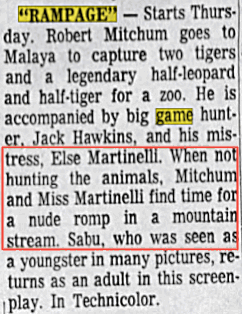
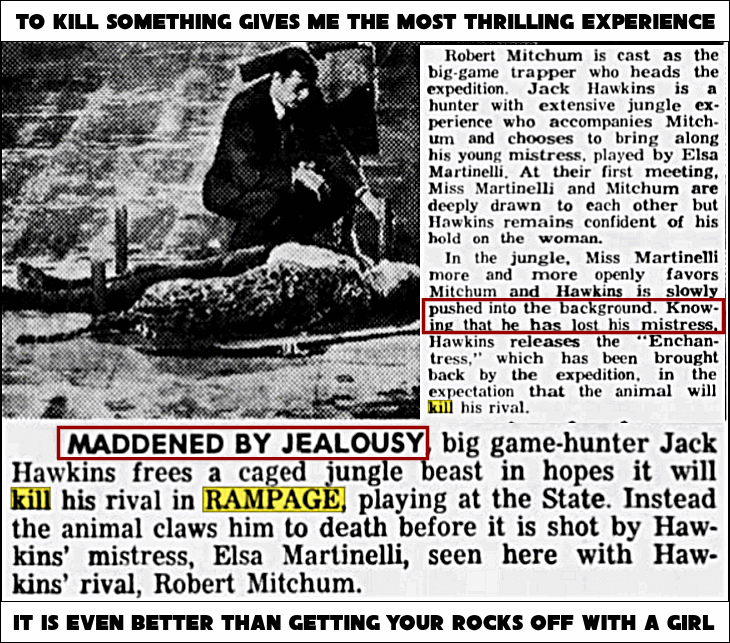
​The movie revolves around two hunters, an American (Robert Mitchum) and a German (Jack Hawkins) who aim to catch a rare breed of panther in Malaysia. The beautiful girlfriend (Elsa Martinelli) of Otto Abbot joins them on their hunt, which further heightens tensions between the two men when Harry Stanton becomes attracted to her. The Zodiac Killer added the encoded phrase in the 408 cipher: "to kill something gives me the most thrilling experience. It is even better than getting your rocks off with a girl". The "Rampage" movie contained a romantic triangle between the three main characters, which also featured Elsa Martinelli bathing naked in a rocky, mountain stream. Bearing in mind that the movie placed emphasis on the attraction of both men towards the woman (the girlfriend of Otto Abbot), it's no wonder the Zodiac Killer referenced that killing is better than "getting your rocks off with a girl" in his decoded cryptogram.    
Picture
The Winona Daily News, October 13th 1963
​The movie "Rampage" was broadcast on US television on July 20th 1969 (Channel 2), 11 days before the July 31st 1969 letters were mailed by the Zodiac Killer - with the movie advertised in the San Francisco Examiner, Sacramento Bee, Oakland Tribune, Berkeley Gazette and Santa Cruz Sentinel, to name just a few.   
Picture
Rampage movie poster and Warner Brothers press book cover
Picture
Opening credits of the movie and the January 1st 1963 paperback book by Alan Caillou
Picture
The Bay Area murderer wrote in his July 31st 1969 letters that "I will cruse around all weekend killing lone people in the night then move on to kill again, until I end up with a dozen people over the weekend". According to the official Warner Brothers press book, Elsa Martinelli was "female enough to attract a dozen men". Was the word "dozen" in the Zodiac Killer's mind when fashioning his trinity of July letters, bearing in mind the other two aforementioned phrases which strongly mirrored the movie poster? "A dozen men" becoming "a dozen people". If so, we have a 1963 movie that is more contemporary to the Zodiac murders, carrying the elements of "go on the rampage" (go on a kill rampage), "the most dangerous game of all" (the most dangerous animal of all), "a dozen men" (a dozen people), and the "crosshairs", In total, it would mean that the Zodiac Killer took 10 words from three phrases (of 13 words in total). But this wasn't all.

The 1963 Rampage movie was based upon a novel first published in 1961 by Alan Caillou, released as a 1963 paperback version with the following wording on the front cover: "A big novel of two white hunters who battle to possess a beautiful woman as they track the jungle for the most dangerous game of all" (see large image above). The rear cover of the 1962 hardbook version read "A killer leopard - and an even more dangerous woman. This is a leopard, Harry. He'll keep close to us just in case he can make a kill. It's the only other animal that kills for the fun of it",  followed by "But the leopard - for the sheer enjoyment of killing, just for the pleasure of it. He kills because he likes it. There's only one other animal that does that, Harry. And that's man". The Zodiac Killer began his 408 cipher with "I like killing people because it is so much fun. It is more fun than killing wild game in the forest because man is the most dangerous animal of all". 

Many newspaper articles featured large advertisements for the Rampage movie, carrying headline statements such as "They lived, loved and fought by the code of the jungle" [1] and "His code was to snare everything" [2]. Therefore, it is quite ironical that the Zodiac Killer would place key phrases from the Rampage movie poster and original Warner Brothers press book within his code, detailing murder. It should be noted that the original Warner Brothers press book also contained the phrase "They lived and loved by the code of the jungle". Could this possibly have influenced the Zodiac Killer to encipher his message on July 31st 1969? ​

Picture
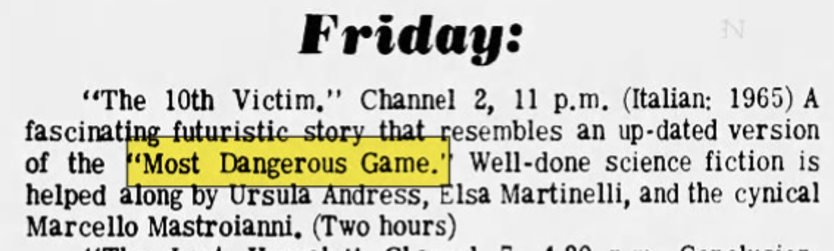
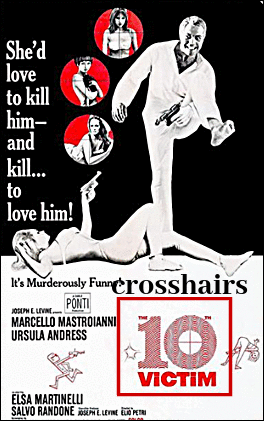
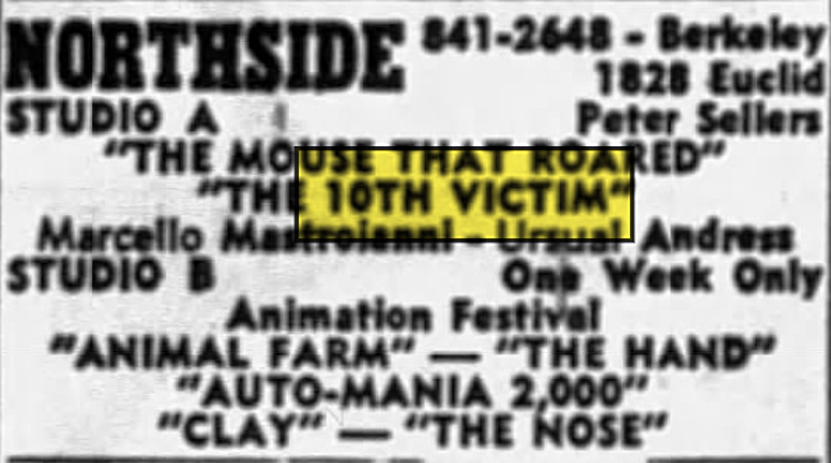
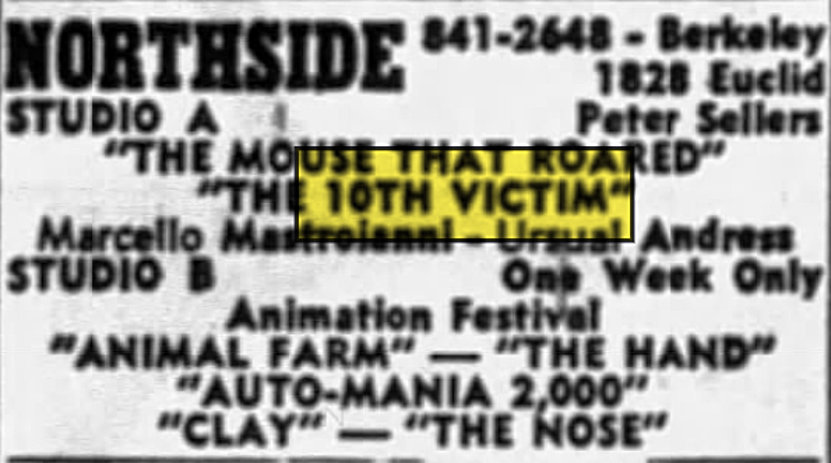
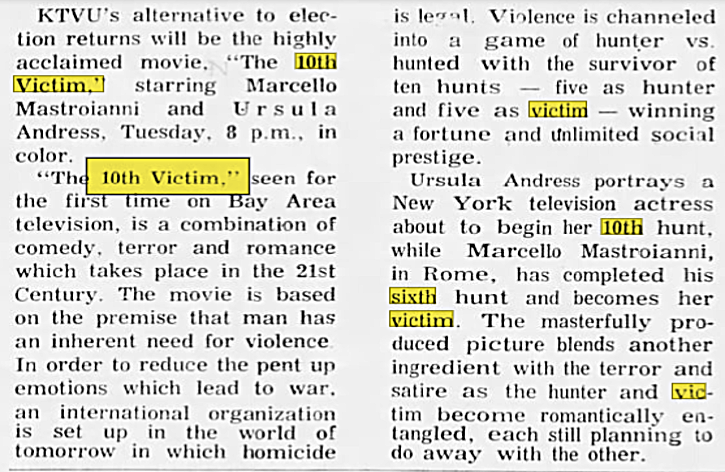
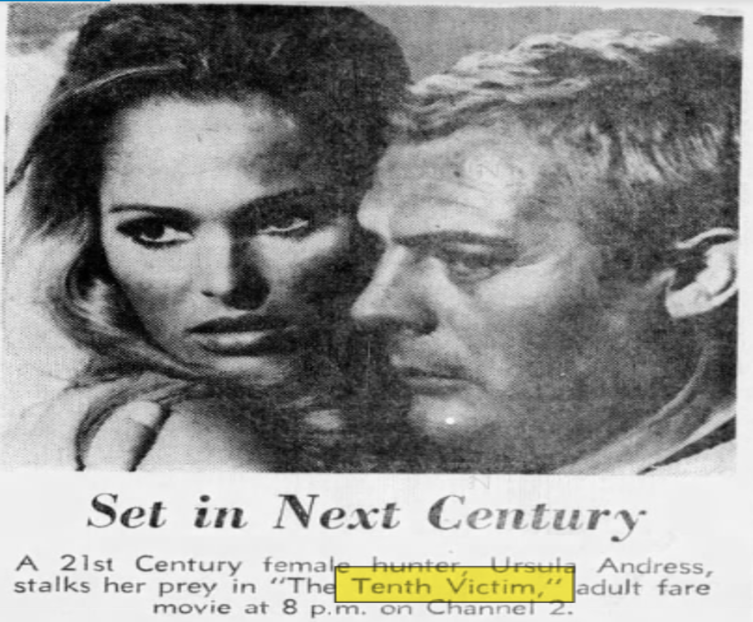
​The Zodiac Killer would start "hunting" people on December 20th 1968 when he murdered David Faraday and Betty Lou Jensen in Benicia - and mentioned this attack in his July 31st 1969 letters, stating "man is the most dangerous animal of all". Two weeks prior to these letters arriving at the San Francisco Chronicle, San Francisco Examiner and Vallejo Times-Herald, the movie "The 10th Victim" (1965) was playing at the Northside Theatre in Berkeley on July 15th 1969. This movie had appeared many times on US television screens throughout 1969. "The 10th Victim" was based on Robert Sheckley's 1953 short story "Seventh Victim", which was an updated version of the "Most Dangerous Game". The story centered on "The Big Hunt", in which contestants from around the world act as "hunters" and "victims" in two-person battles to the death as a means of avoiding mass warfare. 

​This movie may have featured in the Zodiac Killer's sequel communication on December 20th 1969, the first anniversary of the murders of David Faraday and Betty Lou Jensen, which began his "Big Hunt". The movie "The 10th Victim" was 
released into US cinemas on December 20th 1965. The only time the Zodiac Killer wrote a victim count in tandem with the word victim (victom) was when he mailed the Melvin Belli letter on December 20th 1969, stating he was in danger of losing control and claiming his "tenth victim". We have a movie based on "The Most Dangerous Game" released on December 20th 1965 about hunting victims, followed by the Benicia murders on December 20th 1968, followed by the Melvin Belli letter on December 20th 1969, threatening a ninth and "tenth victim". 

Picture
Picture1965 Movie Poster with crosshairs
This movie co-starred Ursula Andress, who played Caroline Meredith, a huntress who had just killed her ninth victim and was looking for a tenth. See here for confirmation. The Zodiac Killer made a point of mentioning his ninth and tenth victim in his letter to Melvin Belli.. The co-star of Ursula Andress was Italian actress Elsa Martinelli, who also starred in the movie "Rampage" (1963), two years earlier.

​"The 10th Victim" and "The Big Hunt" spoke of "control", just like the Melvin Belli letter. Early in the movie, the "announcer" laid out the benefits of "The Big Hunt" over the tannoy system, stating "If you would do away with the terrible wars of the masses, become a member of the Big Hunt. Make your murders legal. Only the Big Hunt can give the world a feeling of true security. An enemy a day keeps the doctor away. Why have birth control when you can have death control. Live dangerously, but within the law. If you are suicidal, the Big Hunt has a special place for you". The Zodiac Killer pleaded "The one thing I ask of you is this, please help me. I cannot reach out for help because of this thing in me wont let me. I am finding it extreamly difficult to hold it in check. I am afraid I will loose control again and take my nineth & possibly tenth victom. Please help me I can not remain in control for much longer".

Just like the "Rampage" movie, "The 10th Victim" had the crosshairs present within the movie title, as shown in the original 1965 poster.on the right.  

Therefore, we have two movies in 1963 and 1965 about hunting, both more contemporary to the Zodiac murders, carrying the elements of "go on the rampage" (go on a kill rampage), "the most dangerous game of all" (the most dangerous animal of all), "a dozen men" (a dozen people), "the movie phrase in the code", the "crosshairs" in both movie titles, "The 10th Victim" (tenth victim), "The Big Hunt and control" and the date of December 20th running through 1965, 1968 and 1969. So was "The Most Dangerous Game" the primary inspiration for the July 31st 1969 letters? 

Picture
Picture
Picture
Picture
"The 10th Victim" featured at the Northside Theatre in Berkeley on July 15th 1969,

ADDITIONAL INFORMATION 

Here is another brief summary of the Rampage movie: "A British big game trophy hunter, Otto Abbot, is offered a job by a West German zoo to capture a pair of Malay tigers and a rare leopard-tiger hybrid known as "the Enchantress". He recruits one of the world's top trappers for the job, American Harry Stanton. Abbot intends to bring along his longtime young mistress, Anna, an Italian waif whom he has kept as a ward since she was 14". During the movie, passion for Anna (Elsa Martinelli) heightens between the two game hunters, which becomes more deadly as the movie nears its end. Hence the wording on the movie poster and original Warner Brothers press book cover, stating "The woman who was the most dangerous game of all". Otto
Abbot realizes he's in danger of losing his "most prized" trophy, as Anna becomes the key "prize" for both game hunters in the Rampage movie (see below). The Zodiac Killer would mail another cryptogram of 148 characters around May 1971, which carried the phrase "man is the most prized game" in the accompanying letter. Therefore, we have two communications containing the phrases "man is the most dangerous animal of all" (in the 408 cipher) and "man is the most prized game" (with the 148 cipher), both of which have relevance to the film. The Bay Area murderer would also mimic the crosshairs from the opening sequence of the Rampage movie at the foot of the 1971 letter, dispensing with the overhanging lines. See here.   
Picture
The following is from the introduction page of Alan Caillou's Rampage book, describing how Anna was "as much the prize" as the wild game they were pursuing. The Zodiac Killer, having targeted both male and female victims, would claim in 1971 that "man is the most prized game", just like Elsa Martinelli was portrayed in the movie.

FURTHER READING: THE AUTHOR OF RAMPAGE IN PARADISE  
Picture

THE INSPIRATION FOR THE 408 CRYPTOGRAM AND BEYOND?

1/18/2024

 
Picture
When the newspaper articles about the Lake Herman Road murders of David Faraday and Betty Lou Jensen were tailing off by March 1969, what inspired the Zodiac Killer to start using cryptograms within his opening letters to the San Francisco Chronicle, San Francisco Examiner and Vallejo Times-Herald on July 31st 1969? As we've seen with many other letters mailed by the Zodiac Killer, his primary inspiration for the design of his communications comes from recent newspaper articles. As reported in the "Hartford Courant" newspaper on March 2nd 1969 (and others), Joseph Verner Reed released a book called "Fun With Cryptograms" in 1968 and "Fun With Codes" in January 1969, ranging from easy to extremely difficult challenges. 

Joseph Verner Reed "was
a hustling theatrical entrepreneur in New York, a land developer in Florida, a diplomat in Paris, a newspaper reporter, art collector, author and loving compiler of word games and cryptograms". Quote from the New York Times. His cryptograms featured in newspapers around the USA on a regular basis over many years and throughout 1969. His love of cryptograms and word games, ever present, and often under the banner of puzzles in the newspapers, reminds one of the "concerned citizen" card mailed on August 10th 1969 to Sergeant John Lynch, which stated "Working puzzles criptograms and word puzzles is one of my pleasures". However, that is the least interesting thing about Joseph Verner Reed and a possible Zodiac connection. 

Did the Zodiac Killer employ a play on words when he wrote "I want you to print this cipher on the front page of your paper. In this cipher is my idenity [sic]" in his message to the San Francisco Chronicle, or when he began his 408 cipher with "I like killing people because it is so much fun", and finally wrote "By the way, are the police having a good time with the code" in his "Debut of Zodiac" letter on August 4th 1969. His use of the word "fun" and the phrase "good time with the code", not dissimilar to Joseph Verner Reed's book entitled "Fun With Codes". The Zodiac Killer altering "fun with codes" into the singular "good time with the code". ​But the crucial part is where the Zodiac Killer offers us his identity within the cryptogram (name being part of identity)..I wondered what inspired the Zodiac Killer to claim he embedded his name within the cryptogram, despite later admitting in the decoded 408 that his promise was an empty one, by stating "I will not give you my name because you will try to slow down or stop my collecting of slaves for my afterlife". Joseph Verner Reed would place his name within the cryptograms he designed (his forename and middle initial), as can be seen in the numerous examples from 1969 shown below. Joseph Verner Reed's book was advertised in the newspapers in 1969, we have the similarity of "fun" and "good time" with codes, and we have the promise and deliverance of a name within a cryptogram by the Zodiac Killer and Joseph Verner Reed respectively. 
Picture

A MORE CONTEMPORARY "DANGEROUS GAME"
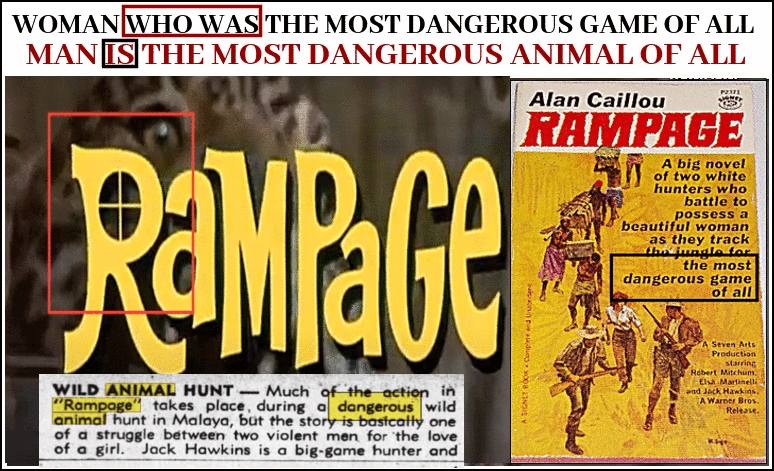
12/26/2023

 
Picture
For many Zodiac Killer researchers the murderer of five appeared to have a fascination with dates, which included the Melvin Belli letter (12/20/69) mailed on the first anniversary of the Lake Herman Road murders, the Pines card (3/22/71) mailed on the first anniversary of the Kathleen Johns abduction, and the mailing of the Los Angeles letter (3/13/71) which coincided with the release date of the Vanishing Point movie, that also referenced "blue meanies". The January trailer of the movie featured a radio host from KOW, who stated "And there goes the Challenger being chased by the Blue, Blue Meanies on wheels. They want to get him and put him away, but there'll have to catch him first". The author of the Los Angeles letter stated "If the Blue Meannies are evere going to catch me, they had best get off their fat asses + do something". 

​
These are just three examples. But for now, we will examine the long-held belief that the Zodiac Killer was referencing the "The Most Dangerous Game" by Richard Connell (first published on January 19th 1924) when he encoded the wording "I like killing people because it is so much fun. It is more fun than killing wild game in the forest because man is the most dangerous animal of all". The Richard Connell short story was later adapted for screenplay, most notably in the 1932 RKO Pictures version starring Joel McCrea and Leslie Banks. While "The Most Dangerous Game" may be the inspiration for the Zodiac Killer's choice of words in the 408 cipher, did another more recent movie inspire him to find "The Most Dangerous Game". 
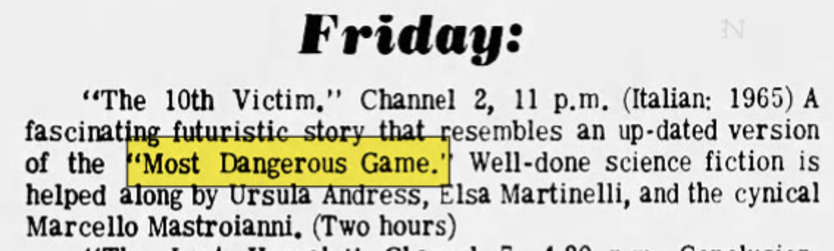
The Zodiac Killer's July 31st 1969 letters to the San Francisco Chronicle, San Francisco Examiner and Vallejo Times-Herald opened up with the wording "
I am the killer of the 2 teen-agers last Christmass at Lake Herman" and "This is the murderer of the 2 teenagers last Christmass at Lake Herman". It was the double murder of David Faraday and Betty Lou Jensen on December 20th 1968 (with the Zodiac claiming a "pencil flashlight" attachment to his gun) that most resembled a killer hunting game, as referenced in the 408 cipher. This was the crime that began the canonical Zodiac murders.    

Picture
The Napa Valley Register, April 26th 1969
Throughout 1969 a movie called "The 10th Victim" was regularly featured on American television. It was "a 1965 science fiction film directed and co-written by Elio Petri, starring Marcello Mastroianni, Ursula Andress, Elsa Martinelli, and Salvo Randone,. based on Robert Sheckley's 1953 short story "Seventh Victim". Taking place in the year 2079 in the aftermath of World War III, the film's focus is on a government-endorsed program known as "The Big Hunt", whereby contestants from around the world act as "hunters" and "victims" in two-person battles to the death as a means of avoiding mass warfare. The "Seventh Victim" was about a future society that has eliminated major warfare by allowing members of society who are inclined to violence to join The Big Hunt, a human hunting game. This eliminates the approximately one quarter of the population that would otherwise be a danger. The story follows an experienced hunter who is excited to receive his latest mission, but is faced with the concern that something is seriously wrong with the assignment. Robert Sheckley's inspiration for "Seventh Victim" was the earlier short story, The Most Dangerous Game, by Richard Connell". Oddly, seven victims was the first total claimed by the Zodiac Killer on November 8th 1969. "The 10th Victim" would be shown at the Northside Theatre in Berkeley on July 15th 1969, just over two weeks prior to the "The Most Dangerous Animal" reference in the 408 cipher. 
Picture
The 408 cipher and its perceived reference to "The Most Dangerous Game" was accompanied by the beginning of the Zodiac murders on December 20th 1968. "The 10th Victim", based on "The Most Dangerous Game", was released into US cinemas on December 20th 1965. The Melvin Belli letter on December 20th 1969 implied that the Zodiac Killer was going to lose control and claim his 10th victim. The only time the Zodiac Killer wrote a victim count in tandem with the word victim (victom) was when he mailed the Melvin Belli letter on December 20th 1969. His next communication on April 20th 1970 would confirm "ten people to date". Irrespective of this movie date matching the Lake Herman Road murders and Melvin Belli letter, did the Zodiac Killer become influenced by "The Most Dangerous Game" through "The 10th Victim", which was contemporary to television and theater in 1968 and 1969? The movie first appeared on Bay Area television on November 5th 1968, the month before the murders of David Faraday and Betty Lou Jensen in Benicia. Below are two advertisements for the movie in the Contra Costa Times and San Francisco Examiner.

RAMPAGE (1963)- THE MOVIE BEHIND THE 408 CIPHER & JULY 31ST LETTERS
Picture
Contra Costa Times, November 3rd 1968
Picture
The San Francisco Examiner, November 5th 1968

THE LANGUAGE OF A VALLEJO KILLER? AN ANALYSIS OF THE FIRST FOUR LETTERS.

11/28/2023

 
Picture
At a time when finding Zodiac Killer DNA and solving this case is heavily debated and in question, one of the most important things to explore are the vast number of communications sent by the killer, with a view to unearthing something within them that points towards his identity and/or home location (anchor point) when committing the murders. No doubt the Zodiac Killer used caution in this regard when composing his communications, but no matter how careful and attentive you are in preventing the accidental leakage of vital information to law enforcement through your wording, mistakes and oversight can often happen. When a murderer is questioned about a missing person, they will often stray into the territory of referring to that missing person in the past tense, because they are knowledgeable to the fact they have killed them. The study of language in interviews and written form can often reveal vital information about a criminal which they have subconsciously revealed, but were incapable of preventing because of their lived experience.

​This may have been the case in the very first letters authored by the Zodiac Killer on July 31st 1969 and August 4th 1969, both of which, possibly revealed the home location of the killer (or his anchor point when perpetrating the crimes). You will notice in his July 31st 1969 letters when addressing the San Francisco Chronicle or San Francisco Examiner first, the Zodiac Killer refers to posting letters to these newspapers in the past tense of "have". In other words, suggesting the significant time that has elapsed, and the distance he has traveled before returning home. When first addressing the Vallejo Times-Herald in his July 31st 1969 letters he uses the present tense of "are", because (possibly) he doesn't associate any great time and distance to the Vallejo Times-Herald offices, as they are within his close proximity. They are in his "here and now". If you left your house in Vallejo and mailed three letters into a San Francisco mailbox, before returning home - you would write "Here is a cyipher or that is part of one. the other 2 parts have been mailed to the S.F. Examiner + the S.F. Chronicle" (associating distance to these two newspaper offices). If you live in Vallejo and are addressing the Vallejo Times-Herald first in two instances, you would write "Here is a cipher or that is part of one. The other 2 parts are being mailed to the Vallejo Times + S.F. Chronicle" or "Here is part of a cipher the other 2 parts of this cipher are being mailed to the editors of the Vallejo Times and SF Examiner". The Zodiac Killer uses the word "are" in both instances he immediately addresses the Vallejo Times-Herald offices (because he doesn't associate distance to this newspaper office). He uses the present tense of "are" to associate something in his lived "mental map" or "here and now". Of course, this isn't conclusive evidence he lived in Vallejo for his first two crimes, but it may point to a subconscious use of language that he failed to keep in check. There is similar language used at the beginning of his next communication on August 4th 1969.              

Picture
The following reasoning may seem innocuous and insignificant, but it's just another example of how language could point us in the direction of a Vallejo killer. When the Zodiac Killer opened up in his August 4th 1969 mailing, he wrote "This is the Zodiac speaking. In answer to your asking for more details about the good times I have had in Vallejo, I shall be very happy to supply even more material". What he didn't write is this:"This is the Zodiac speaking. In answer to your asking for more details about the good times I had in Vallejo, I shall be very happy to supply even more material". The Zodiac Killer used the present perfect tense of "have had" rather than the past tense of "had". The present perfect tense, in this example, suggests that the Zodiac Killer has had good times in Vallejo but they are not complete. The word "had" implies a distinct separation from the past to the present, whereas "have had" implies a distinct connection from the past to the present. The "good times I have had in Vallejo" being congruent with somebody still living in this location. Although tenuous, this subtle use of language is important to analyse in conjunction with the previous example highlighted  The third example will focus on the anomaly of a phone call made to the Vallejo Police Department 40 minutes after the Blue Rock Springs attack, from a payphone located just 10 minutes from the crime scene. 

It has been widely noted that a killer living in San Francisco, Napa, Oakland, or any distant home location, could easily have made this phone call at 12:40 am from any payphone in the Bay Area, rather than place a phone call in close proximity to the police station he was delivering his message - and seemingly hanging around for an unnecessary 30 minutes, thereby risking detection. This has opened up the notion of a killer who lived in close proximity to the Springs & Tuolumne payphone, who secured his vehicle, removed any incriminating evidence and walked to the payphone from a nearby residence. This is where further language analysis could point us to a Vallejo resident, or otherwise. It depends on what merit you apply to the above arguments, in conjunction to the ones I'm about to present. ​      
Picture
The Zodiac Killer went on to write "I did not leave the cene of the killing with squealling tires + raceing engine as described in the Vallejo paper. I drove away quite slowly so as not to draw attention to my car", and "When I hung the phone up the damn thing began to ring & that drew his attention to me + my car". In the second statement the Zodiac Killer felt the necessity to highlight both him and his car. The phone apparently rang when he hung up the phone, so why didn't the Zodiac Killer just state "When I hung the phone up the damn thing began to ring & that drew his attention to me".

When he left the Blue Rock Springs parking lot he made the point of driving away slowly so as not to draw attention to his car, yet by the payphone he is making sure that investigators draw the conclusion that the eyewitness saw both him and his vehicle, despite apparently positioned at the payphone independent of his car. It could be concluded that his car was still running, and it would have been obvious to the eyewitness that he and his vehicle were in tandem (and so provided this information), but it certainly wasn't necessary to provide investigators with corroboratory evidence that his car was brown as reported in the newspapers, by stating "The man who told police that my car was brown was a negro about 40-45 rather shabbly dressed. I was in this phone booth having some fun with the Vallejo cop when he was walking by". Unless of course, his vehicle wasn't brown, The biggest red flag to his vehicle being present in the vicinity of the payphone, is the description given by the Zodiac Killer about the eyewitness.

The Zodiac Killer only went into detail regarding his murder victims when it benefited his case of proof, such as the description of clothing worn by Darlene Ferrin, or the movement of the living victims and bodies in relation to the crime scene. So why didn't the Zodiac Killer just write 
"The man who told police that my car was brown, noticed me + my car when he was walking by". What relevance does his race, clothing or age have to do with anything? The descriptive nature of "negro", "40-45" and "shabbily dressed" brings this eyewitness to life and makes him more believable to the reader of the letter. The Zodiac Killer, by describing this man in detail, may have been attempting to corroborate that his vehicle was present by the payphone, and was brown in color. The Zodiac Killer had previously supplied extra details to the police when it helped his cause, so the unnecessary inclusion of this man's description in the letter, could again, be viewed as beneficial to him. If the Zodiac Killer wanted to deflect away from a home location nearby, he had to create a vehicle that can take him anywhere, and supply an eyewitness to corroborate this fact. Not just any eyewitness, but a believable middle-aged, black man, with questionable clothing.   

These observations regarding the language used by the Zodiac Killer are not proof he resided in Vallejo or near the payphone, but they should provide the impetus to examine later communications mailed by the killer, who may have unwittingly left more offerings to further bolster the case argued here. Or maybe dispel it entirely.   

<<Previous
    Picture
    Picture
    Picture

    All
    13 Hole Postcard
    148 Character Cipher
    1978 Letter
    1986 Letter
    1987 Letter
    2001 Happy New Year Card
    Albany Letter
    Allan/Peyton Murders
    Arthur Leigh Allen
    Atlanta Letter
    Betsy Aardsma
    Blue Rock Springs Attack
    Bus Bomb Letter
    Button Letter
    Call To Chat Show
    Carol Beth Hilburn
    Channel 9 Letter
    Cheri Jo Bates
    Cipher Theories
    Citizen Card
    Concerned Citizen Card
    Confession Letter
    Daniel Williams Poisoning
    Debut Of Zodiac Letter
    Deep Real Estate Ad
    DMV Letter
    Domingos/Edwards Murders
    Donald Lee Bujok
    Donna Lass
    Dragon Card
    Earl Van Best Jr
    Eureka Card
    Exorcist Letter
    Fairfield Letter
    Fingerprint Evidence
    Forecast For Cancer
    Forecast For Leo
    Gareth Penn
    General News Articles
    Gilbert And Sullivan
    Good Citizen Letter
    Halloween Card
    Hood/Garcia Murders
    Internet Articles
    Joan Webster
    Johnny & Joyce Swindle
    Judith Hakari
    Kevin Robert Brooks
    Lake Berryessa Attack
    Lake Herman Road Murders
    Lake Tahoe Disappearance
    Larry Kane
    Leona Roberts Murder
    Los Angeles Letter
    Melvin Belli Letter
    Mike Morford (Morf13)
    Modesto Attack
    Molina/Rodriguez Murders
    Monticello Card
    My Name Is Letter
    Nancy Bennallack
    New Canaan Letters
    Novato Letter
    Oakland A's Letter
    Pines Card
    Possible Zodiac Attacks
    Possible Zodiac Letters
    Presidio Heights Murder
    Radians
    Red Phantom Letter
    Richard Gaikowski
    Riverside Desktop Poem
    Robert Salem Murder
    Ross Sullivan
    Saechao/Saelee Murders
    San Jose Code Letter
    Santa Claus Card
    Scorpion Ciphers
    Scotch Tape Letter
    Sla Letter
    Tamalpais Valley Attack
    Ted Kaczynski
    Telegraph Avenue Incident
    The 340 Cipher
    The 408 Cipher
    The Celebrity Cypher
    The Little List
    The Mikado
    Thomas Horan
    You Are Next Letter
    Zodiac Letters Poll
    Zodiac Postage
    Zodiac Theories

    Picture

    RSS Feed
    Picture
    Picture
    Picture
    Picture
    Picture
    Picture
    Picture
    The Zodiac Killer may have given us the answer almost word-for-word when he wrote PS. The Mt. Diablo Code concerns Radians & # inches along the radians. The code solution identified was Estimate: Four Radians and Five Inches To read more, click the image.
    Picture
    Picture
    The Zodiac Atlas: The Zodiac Killer Enigma by Randall Scott Clemons. Click image for details.
    Picture
    The Zodiac Killer Map: Part of the Zodiac Killer Enigma by Randall Scott Clemons. Click image for color version
    For black and white issue..
    Picture
    Picture
    Picture
    Picture
    Picture
    Picture
    Picture
    Picture
    Picture
    Picture
    Picture
    Picture
    Picture
    Picture
    Picture
    Picture
    Picture
    Picture
    Picture
    Picture
    Picture
    Picture
    Picture
    Picture
    Picture
    Picture
    Picture
    Picture
    Picture
    Picture
    Picture
    Picture
    Picture
    Picture

    Archives

    November 2025
    October 2025
    September 2025
    August 2025
    July 2025
    June 2025
    May 2025
    April 2025
    March 2025
    February 2025
    January 2025
    December 2024
    November 2024
    October 2024
    September 2024
    August 2024
    July 2024
    June 2024
    May 2024
    April 2024
    March 2024
    February 2024
    January 2024
    December 2023
    November 2023
    September 2023
    August 2023
    July 2023
    June 2023
    May 2023
    April 2023
    March 2023
    February 2023
    January 2023
    December 2022
    November 2022
    October 2022
    September 2022
    August 2022
    July 2022
    June 2022
    May 2022
    April 2022
    March 2022
    January 2022
    December 2021
    November 2021
    October 2021
    September 2021
    August 2021
    July 2021
    June 2021
    May 2021
    April 2021
    March 2021
    February 2021
    January 2021
    December 2020
    November 2020
    October 2020
    September 2020
    August 2020
    July 2020
    June 2020
    May 2020
    April 2020
    March 2020
    February 2020
    January 2020
    December 2019
    November 2019
    October 2019
    September 2019
    August 2019
    July 2019
    June 2019
    May 2019
    April 2019
    March 2019
    February 2019
    January 2019
    December 2018
    November 2018
    October 2018
    September 2018
    August 2018
    July 2018
    June 2018
    May 2018
    April 2018
    March 2018
    February 2018
    January 2018
    December 2017
    November 2017
    October 2017
    September 2017
    August 2017
    July 2017
    June 2017
    May 2017
    April 2017
    March 2017
    February 2017
    January 2017
    December 2016
    November 2016
    October 2016
    September 2016
    August 2016
    July 2016
    June 2016
    May 2016
    April 2016
    March 2016
    February 2016
    January 2016
    December 2015
    November 2015
    August 2015
    July 2015
    June 2015
    May 2015
    April 2015
    March 2015
    February 2015
    January 2015
    December 2014
    November 2014
    October 2014
    September 2014
    August 2014
    July 2014
    June 2014
    May 2014
    April 2014
    March 2014
    February 2014
    January 2014
    December 2013
    November 2013
    October 2013
    September 2013
    August 2013
    July 2013
    June 2013
    May 2013
    April 2013
    February 2013
    January 2013
    December 2012
    November 2012
    October 2012
    September 2012
    July 2012
    January 2012

Picture
Picture
Picture
Picture
Picture
Photos from Marcin Wichary, zAppledot, vyusseem, Alex Barth, Alan Cleaver, jocelynsart, Richard Perry, taberandrew, eschipul, MrJamesAckerley