Expanding on my last article, I have calculated the position and area of the punch-hole on the Pines postcard to 1.96 square miles, and placed it over the map below. If the punch-hole was intended to be a burial or deposition site, then the measurement and direction of this punch-hole with respect to the "Sierra Club" pasting on the card, coupled with the map scale, means that the jawbone of Donna Lass falls inside the punch-hole created by the author of the postcard (shown on the map below).This technique was previously used by the Zodiac Killer on June 26th 1970, when he used radians and inches along those radians to pinpoint the location of a buried bomb. Only this time in the Pines postcard it was a human being.
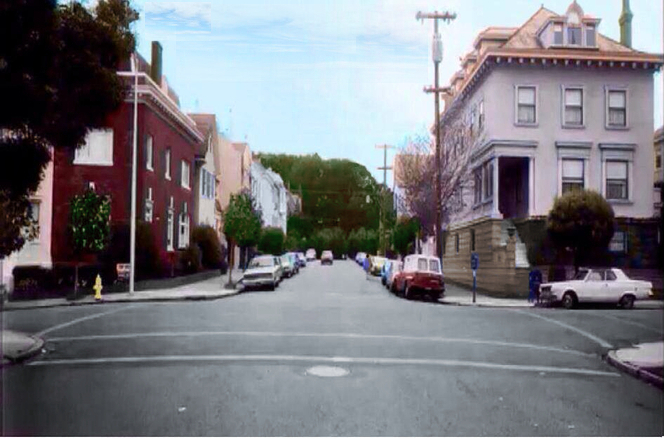
Years ago I identified a location for this bomb alongside a road close to Ingleside Police Station of 4 radians and 5 inches (tilted to Magnetic North). Long time Zodiac researcher, Andrew Gray, later took these measurements and slotted them into the Z32 code, reading "Estimate Four Radians and Five Inches". The word "estimate" allowed for a margin of error. In the Zodiac Killer's Bus Bomb letter on November 9th 1970, he may have used the 9 o' clock position tilted to Magnetic North to identify the Salesian High School of teacher Daniel Williams, who had just been targeted for death by somebody claiming to be the Zodiac Killer. So this technique of using a clock face, radians and inches (measurements) to identify a location, is not without precedent. On this occasion the Pines postcard author placed the punch-hole of 1.96 square miles.over the remains of Donna Lass. This location also landed on the 9 o' clock position of a clock face from the Sierra Club of Clair Tappaan Lodge. But were these measurements created deliberately by the Zodiac Killer, or was he just lucky when he applied the "Sierra Club" and punch-hole 2.19 inches apart on the same horizontal plane, and used "around in the snow" upside down. It's rather curious that the newspaper read in January 1986 that remains had been "found in 2 inches of snow", given that the author of the postcard likely expected her to be found "around in the snow".
Years ago I identified a location for this bomb alongside a road close to Ingleside Police Station of 4 radians and 5 inches (tilted to Magnetic North). Long time Zodiac researcher, Andrew Gray, later took these measurements and slotted them into the Z32 code, reading "Estimate Four Radians and Five Inches". The word "estimate" allowed for a margin of error. In the Zodiac Killer's Bus Bomb letter on November 9th 1970, he may have used the 9 o' clock position tilted to Magnetic North to identify the Salesian High School of teacher Daniel Williams, who had just been targeted for death by somebody claiming to be the Zodiac Killer. So this technique of using a clock face, radians and inches (measurements) to identify a location, is not without precedent. On this occasion the Pines postcard author placed the punch-hole of 1.96 square miles.over the remains of Donna Lass. This location also landed on the 9 o' clock position of a clock face from the Sierra Club of Clair Tappaan Lodge. But were these measurements created deliberately by the Zodiac Killer, or was he just lucky when he applied the "Sierra Club" and punch-hole 2.19 inches apart on the same horizontal plane, and used "around in the snow" upside down. It's rather curious that the newspaper read in January 1986 that remains had been "found in 2 inches of snow", given that the author of the postcard likely expected her to be found "around in the snow".

|

|